About Me
I am an associate professor at the University of Haifa's Mathematics Department.
My research revolves around classical algebraic groups and their applications in algebraic geometry and number theory. I am also interested in high-dimensional expanders and their applications to theoretical computer science.
Contact Information
- E-mail: Replace the string "nowhere" with "haifa" in ufirst@univ.nowhere.ac.il
- Address: Department of Mathematics, University of Haifa, 199 Abba Khoushy Avenue, Haifa, Mailbox: 3338, Zip code: 3103301, Israel.
- Office: Education and Science building, 6th floor, room 606.
- Office Tel: +972-4-824-9168 (or 53168 from a university phone).
Some Research Interests
- Classical algebraic groups and their homogeneous spaces
- Quadratic and hermitian forms
- Central simple algebras, Azumaya algebras and their involutions, the Brauer group
- High-Dimensional Expanders: arithmetic and computer science aspects
Something I recommend listening to:
on YouTube (it is usually classical music, and I change it from time to time).
Publications
Preprints
- Hypergraph Samplers: Typical and Worst Case Behavior, with V. Levi Alev. [arXiv]
- The Cheeger Inequality and Coboundary Expansion: Beyond Constant Coefficients, with T. Kaufman. [arXiv]
- Azumaya Algebras With Orthogonal Involution Admitting an Improper Isometry. [arXiv]
- The Ramanujan Property for Simplicial Complexes. [arXiv] [Highlights]
Research Papers
- Good Locally Testable Codes with Small Alphabet and Small Query Size, with S. Lazarovichi. [arXiv] [RANDOM 2026]
- Algebraic Groups with Torsors That Are Versal for All Affine Varieties, with M. Florence and Z. Rosengarten, Algebra and Number Theory, to appear. [arXiv]
- Irredundant generating sets for matrix algebras, with Y. Blumenthal, Linear Algebra and its Applications, 727:308–335 (2025). [Journal] [arXiv]
- Counterexamples in Involutions of Azumaya Algebras, with B. Williams, Journal of Algebra, 684:256–279 (2025). [Journal] [arXiv]
- Spaces of Generators for Azumaya Algebras with Unitary Involution, with O. Cantor, Journal of Pure and Applied Algebra, 229(4):107919 (2025). [Journal] [arXiv]
- Highly Versal Torsors, Amitsur Centennial Symposium, Israel Mathematical Conference Proceedings, Contemporary Mathematics Vol. 800:129-174 (2024). [arXiv] [Journal] [Recorded Talk]
- Cosystolic Expansion of Sheaves on Posets with Applications to Good 2-Query Locally Testable Codes and Lifted Codes, with T. Kaufman. [arXiv] [Overview in STOC 2024] [Recorded Talk]
- An 8-Periodic Exact Sequence of Witt Groups of Azumaya Algebras with Involution, Manuscripta Mathematica, 170:313-407 (2023). [arXiv] [Journal] [Recorded Talk]
- On the Grothendieck-Serre Conjecture for Classical Groups, with Eva Bayer-Fluckiger and Raman Parimala. Journal of the London Mathematical Society, 106(4):2884-2926 (2022). [arXiv] [Journal] [Recorded Talk]
- On the number of generators of an algebra over a commutative ring, with Zinovy Reichstein and Ben Williams. Transactions of The American Mathematical Society, 375(10):7277-7321 (2022). [arXiv] [Journal] [Recorded Talk]
- On The Gersten-Witt Complex of an Azumaya Algebra with Involution. Journal of Algebra, 605:146--178 (2022). [arXiv] [Journal]
- On the non-neutral component of outer forms of the orthogonal group. Journal of Pure and Applied Algebra, 225(1):106477 (2021). [arXiv] [Journal]
- Pfister's Local-Global Principle and Systems of Quadratic Forms. Bulletin of the London Mathematical Society. 52(6):1105-1121 (2020). [arXiv] [Journal]
- Involutions of Azumaya algebras, with B. Williams, Documenta Mathematica, 25:527-633 (2020). [arXiv] [Journal]
- Orders that are Etale-Locally Isomorphic, with E. Bayer-Fluckiger and M. Huruguen, Algebra i Analiz (St. Petersburg Mathematical Journal), 31(4):1-15 (2019). [arXiv] [Journal]
- On Uniform Admissibility of Unitary and Smooth Representations, with T. Rüd, Archiv der Mathematik, 112(2):169-179 (2019). [arXiv] [Journal]
- Azumaya Algebras Without Involution, with A. Auel and B. Williams, Journal of The European Mathematical Society, 21(3):897-921 (2019). [arXiv] [Journal]
- On the number of generators of an algebra, with Z. Reichstein, Comptes Rendus Mathematique, 355(1):5-9 (2017). [arXiv] [Journal]
- Rationally Isomorphic Hermitian Forms and Torsors of Some Non-Reductive Groups, with E. Bayer-Fluckiger, Advances in Mathematics, 312:150-184 (2017). [arXiv] [Journal]
- Patching and Weak Approximation in Isometry Groups, with E. Bayer-Fluckiger, Transactions of the American Mathematical Society, 369:7999-8035 (2017). [arXiv] [Journal]
- Witt's Extension Theorem for Quadratic Spaces over Semiperfect Rings, Journal of Pure and Applied Algebra, 219(12):5673-5696 (2015). [arXiv] [Journal]
- Categorical Realizations of Quivers, Communications in Algebra, 44(6):2567-2582 (2016). [arXiv] [Journal]
- Rings That Are Morita Equivalent to Their Opposites, Journal of Algebra, 430:26-61 (2015). [arXiv] [Journal]
- General Bilinear Forms, Israel Journal of Mathematics, 205(1):145-183 (2015). [arXiv] [Journal]
- An Elementary Proof That Rationally Isometric Quadratic Forms Are Isometric, Archiv der Mathematik, 103(2):117-123 (2014). [arXiv] [Journal] [Python 2.6 Code] [Python 3 Code]
- Hermitian Categories, Extension of Scalars and Systems of Sesquilinear Forms, with E. Bayer-Fluckiger and D.A. Moldovan, Pacific Journal of Mathematics, 70(1):1-26 (2014). [arXiv] [Journal]
- Stiefel-Whitney Invariant for Non-Symmetric Bilinear Forms, with U. Vishne, Linear Algebra and its Applications, 439:1905-1917 (2013). [Journal]
- Semi-Invariant Subrings, Journal of Algebra, 378:103-132 (2013). [arXiv] [Journal]
Other Publications
- On Good 2-Query Locally Testable Codes from Sheaves on High Dimensional Expanders, with T. Kaufman. [arXiv] [Python Code]
- On the number of generators of a separable algebra over a finite field, with Z. Reichstein and S. Salazar. [arXiv]
- Ph.D. Dissertation: Bilinear Forms and Rings with Involution, done under the supervision of professor Uzi Vishne, submitted on 12/2012, approved on 5/2013. [English Title, Abstract & Body] [Hebrew Title & Abstract]
Teaching
- Fall 2026: Linear Algebra I | Introduction to Computer Science
All course websites are on the Moodle system.
Recently Taught
- Spring 2025: Coding Theory
- Fall 2024: Introduction to Algebraic Geometry | Linear Algebra for Physicists
- Spring 2024: Coding Theory | Topology | Advanced Topics in Mathematics | Math for Medical Imaging II
- Fall 2023: Ring Theory | Solving Problems in Mathematics | Mathematics for Medical Imaging
- Spring 2023: Topology | Advanced Topics in Mathematics | Mathematics for Medical Imaging
- Fall 2022: Kodkod (advanced highschool methematics) | Linear Algebra II
- Spring 2022: Topology | Seminar on Quadratic Forms
- Fall 2021: Intrdouction to Algebraic Geometry | The Math Club
- Spring 2021: Topology | Ring Theory
My Research Group
Current Members
- Yidi Wang (postdoctoral fellow)
- Omer Cantor (master student)
Former Members
- Vedat Levi Alev (postdoctoral fellow)
- Liam May (undergraduate research opportunity [UROP] at MIT). Project: Number of Generators.
- Nikola Spirovsky (undergraduate research opportunity [UROP] at MIT). Project: Number of Generators.
- Stav Lazarovich (undergraduate student). Project: Locally Testable Error Correcting Codes (2025).
- Maryam Ayoub (master student). Thesis: Isomorphism of Orders with Involution (2025).
- Yonatan Blumenthal (undergraduate student). Project: Maximal-Size Irredundant Generating Sets (2024).
- Hnady Bokae (master student). Thesis: Azumaya Algebra Over Semilocal Rings (2023).
- Foaad Mossa (master student). Thesis: Constructive Solutions to Some Cases of The Grothendieck-Serre Conjecture (2021).
- Thomas Rüd (master student). Thesis: Admissibility of representations of totally disconnect locally compact groups (2016).
Prospective Students
Interested in working with me? Feel free to email me. Please check my research interests first. Students not from my institution should provide references.
Modular Origami
One of my hobbies is constructing various solids using modular origami.
The models below are mostly made of few to 150+ identical origami units. Theoretically, no cutting or gluing is required for the construction, but I sometimes use glue to make the bodies hold better and longer. The number of days that takes me to make a model is approximately the number of units divided by 3 (because on average I only do about 10 minutes of folding every day).
Some mathematical comments are spread throughout the models. Feel free to ignore them.
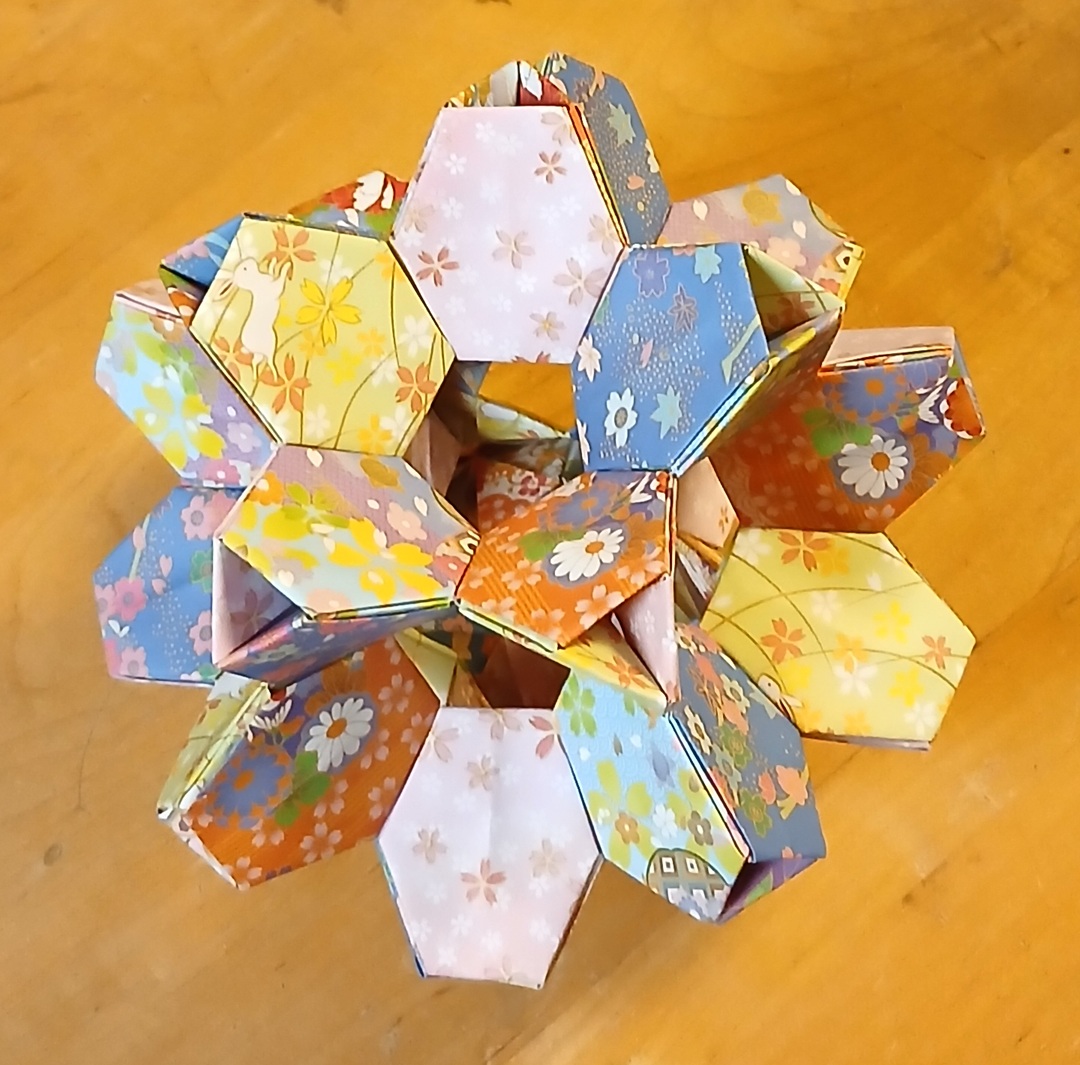
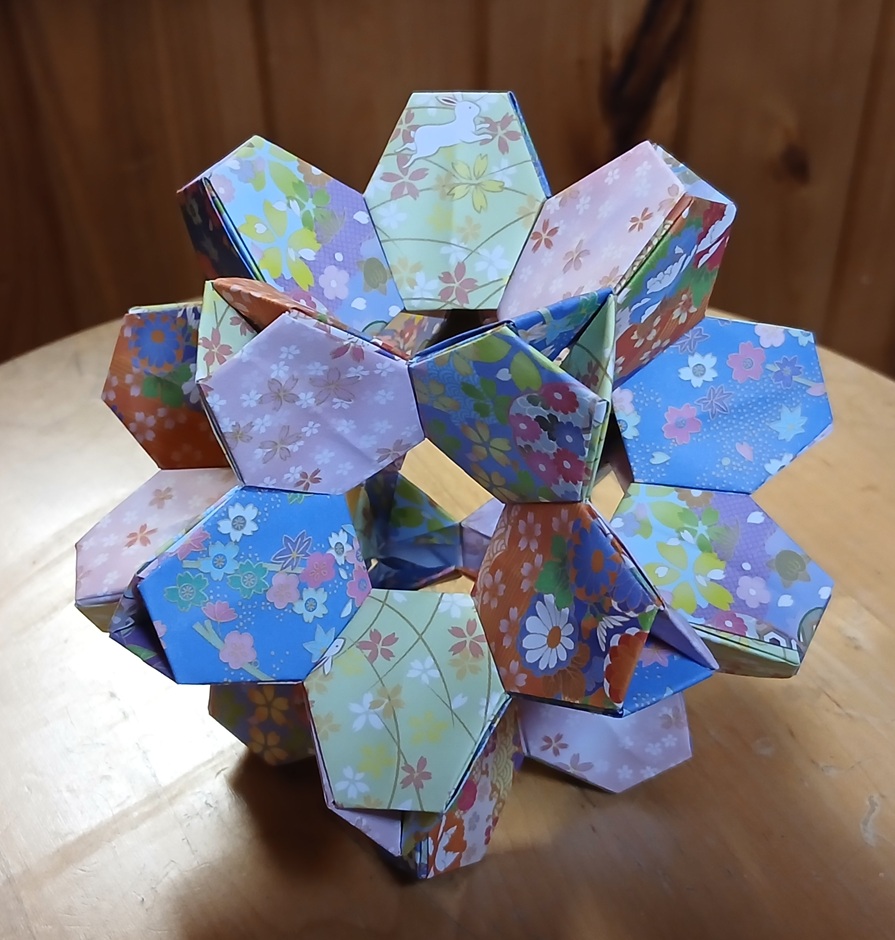
Icosidodecahedron (with truncated pyramids bulging outwards or inwards)
Constructed at Moshava I/O camp, 2026.
Made of 60 identical pieces in 5 colors.
The symmetry group is S5 and the coloring proves it: every rotation induces a permutation of the colors.
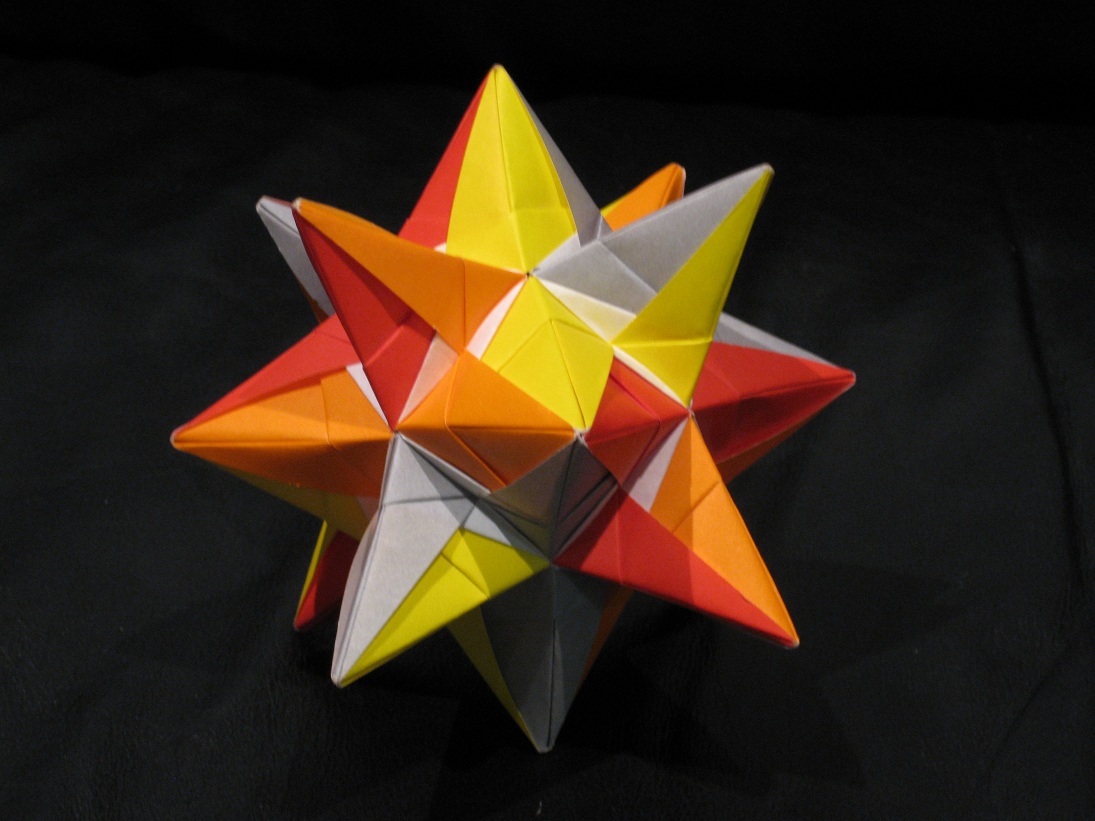
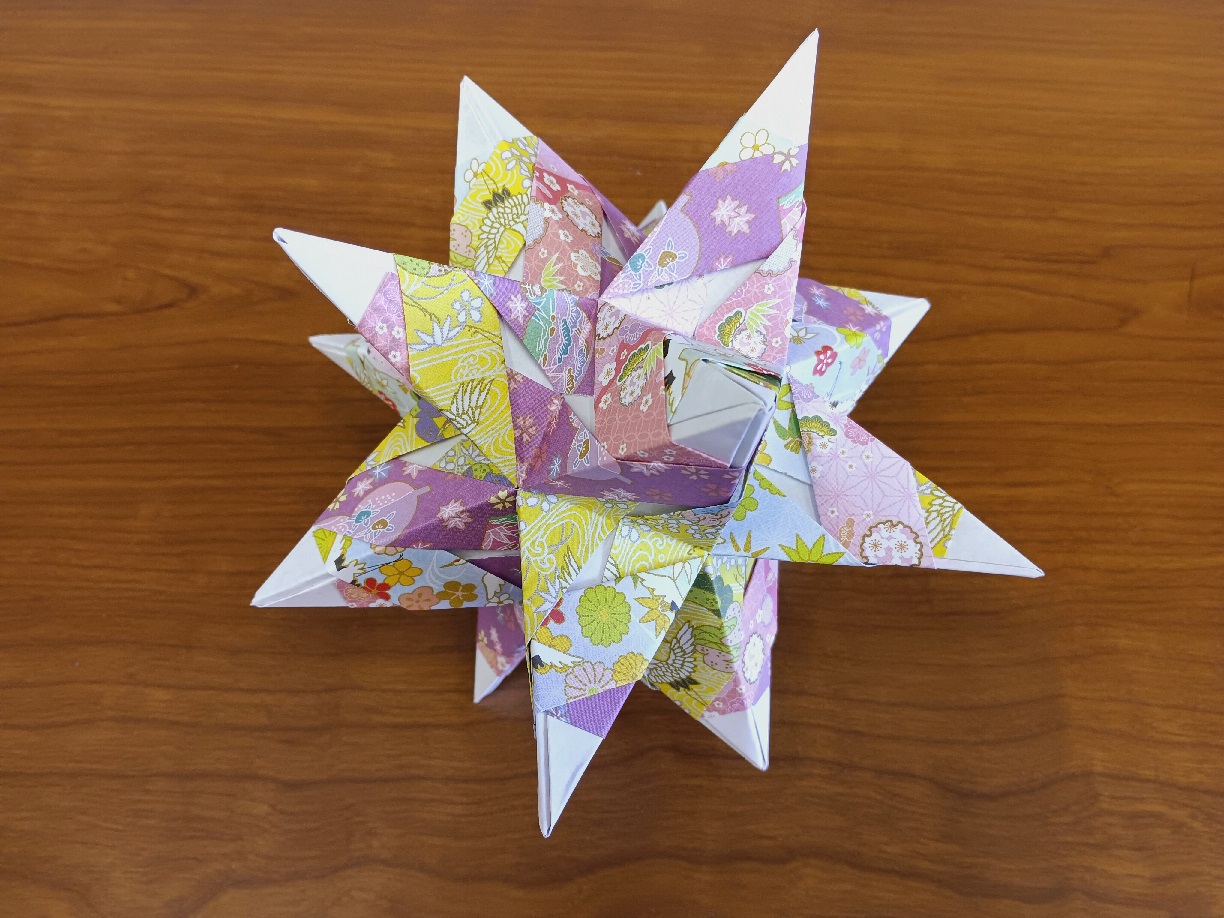
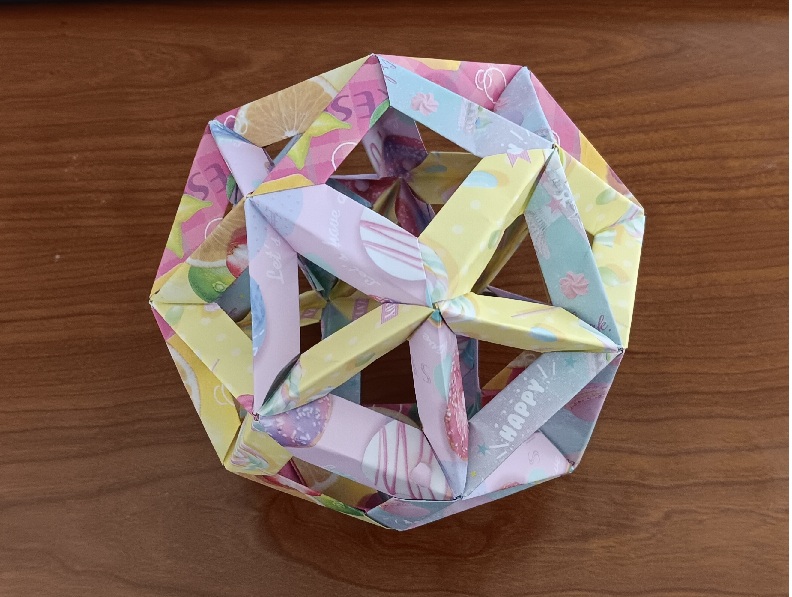
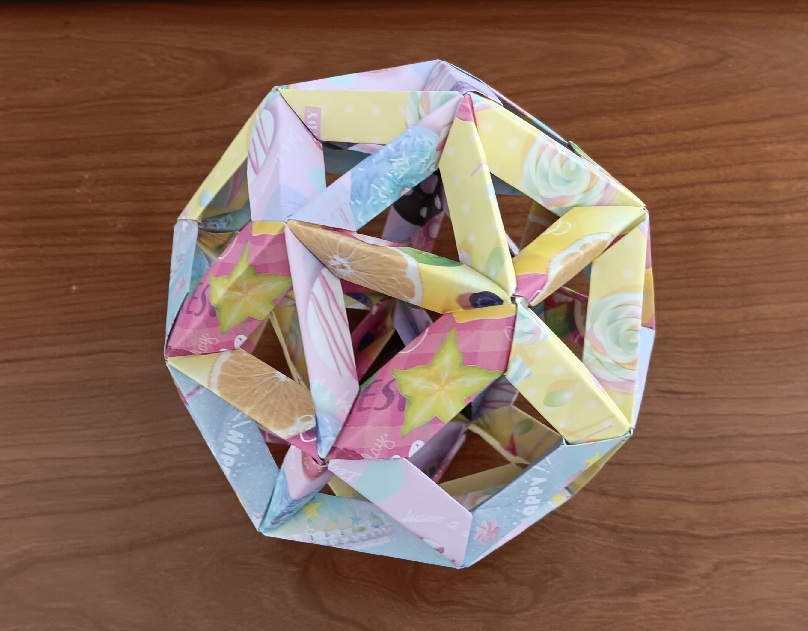
Cuboctahedra (with Pyramids on the Faces)
Made of 24 identical pieces in 4 colors.
The symmetry group is S4 and the coloring "proves" it.
Second model constructed at MIT, 2026.
Snub Cube
Constructed at MIT, 2026.
Made of 60 identical pieces in 4 colors.
The symmetry group is S4 and the coloring proves it: every rotation induces a permutation of the colors.
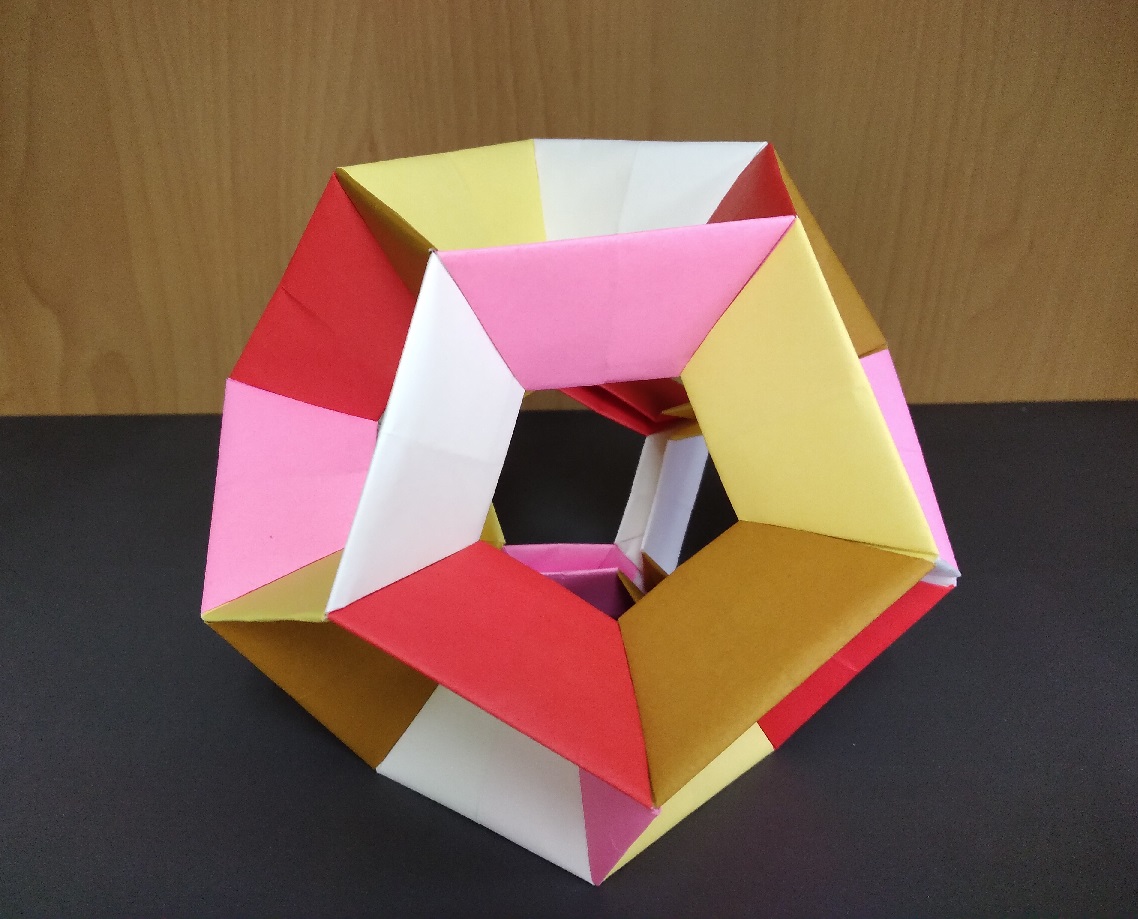
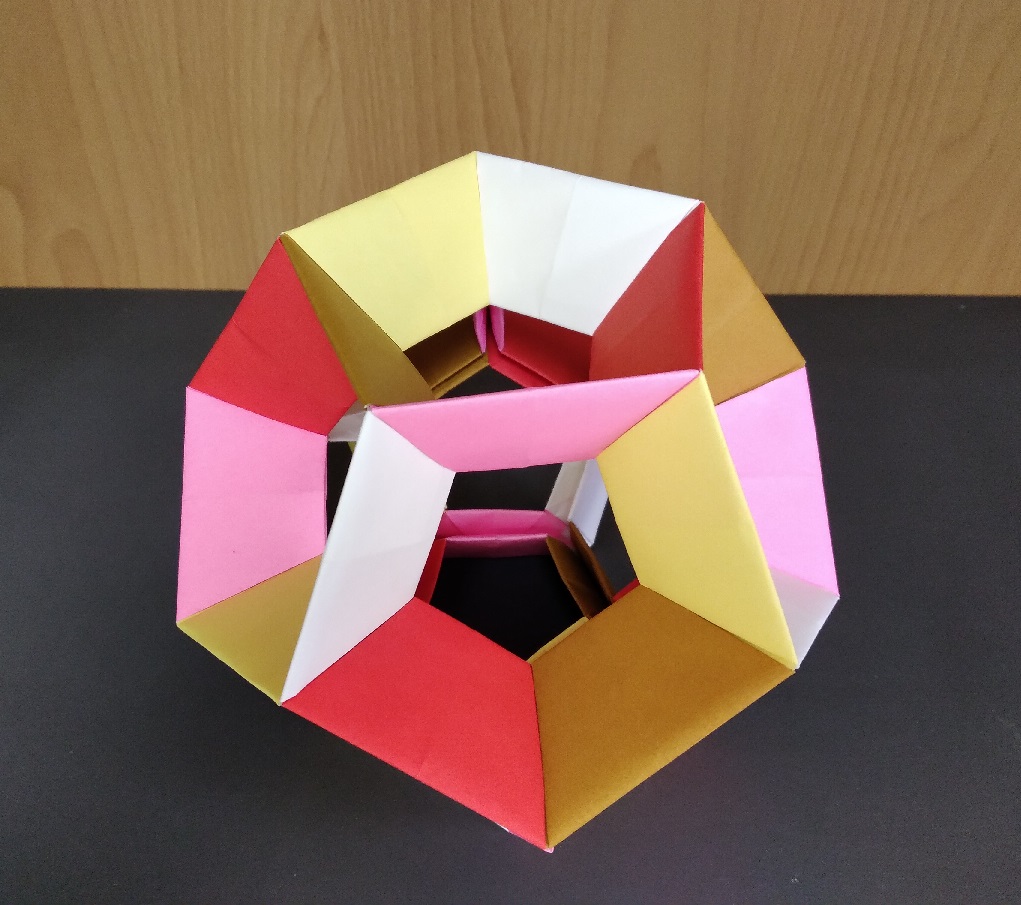
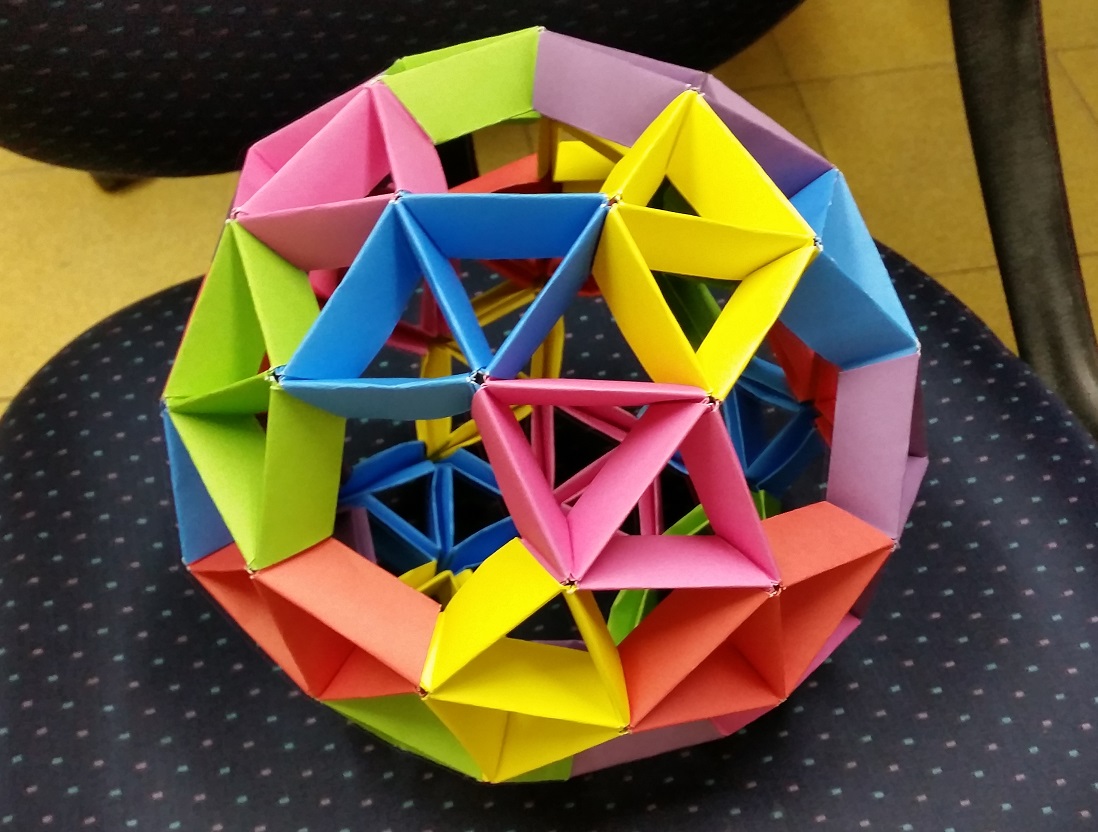
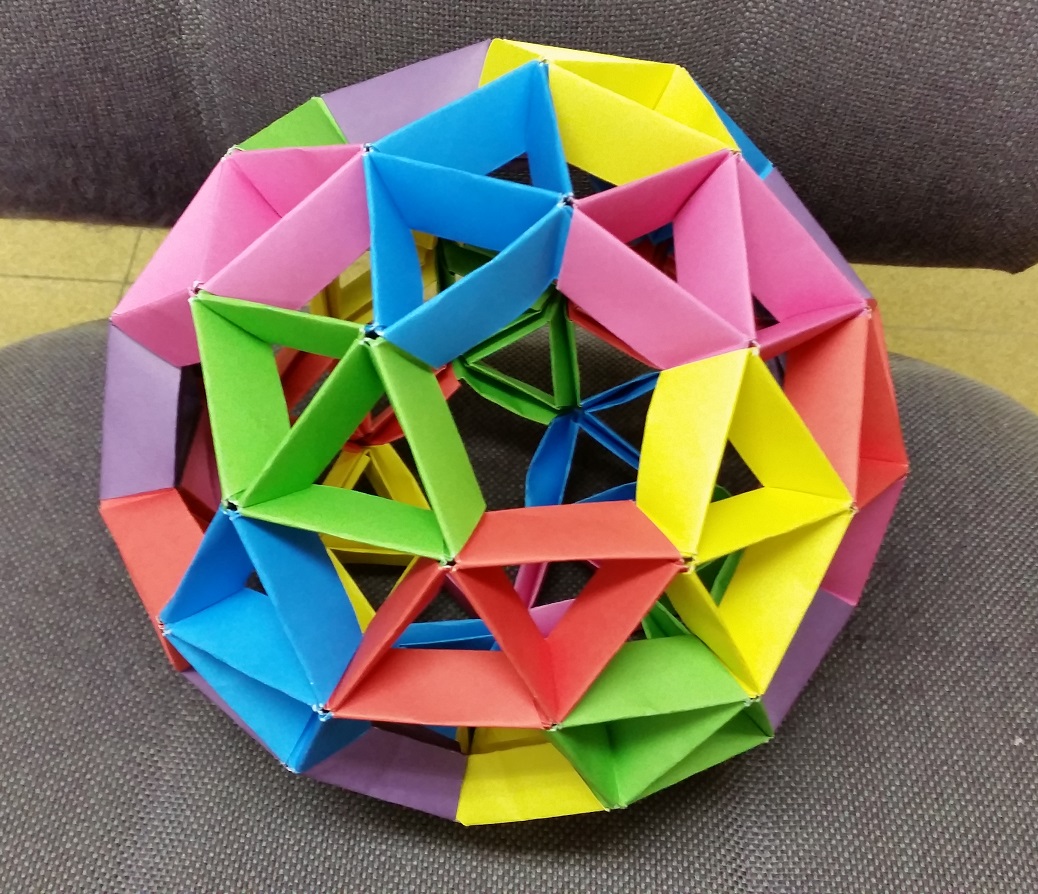
Dodecahedron
Constructed at University of Haifa, 2020.
Made of 30 identical pieces in 5 colors.
The symmetry group is A5 and the coloring consists of orbits of a subgroup isomorphic to A4.
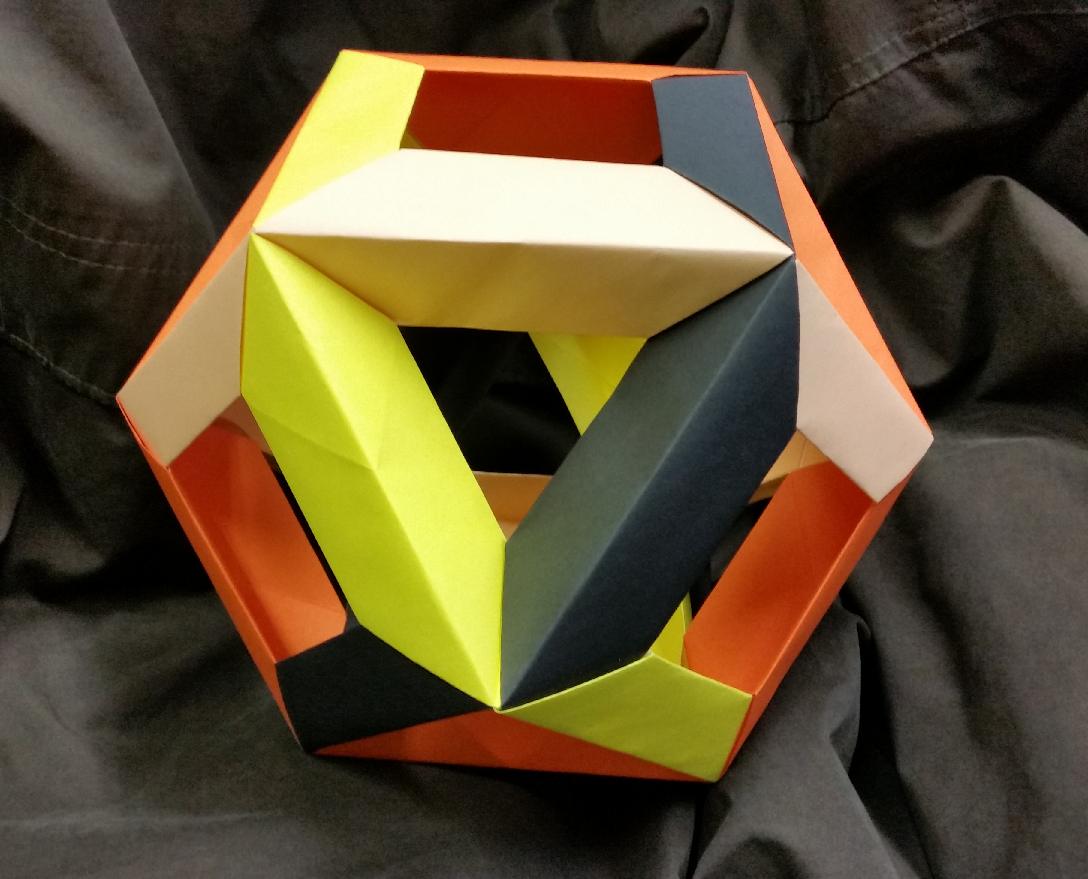
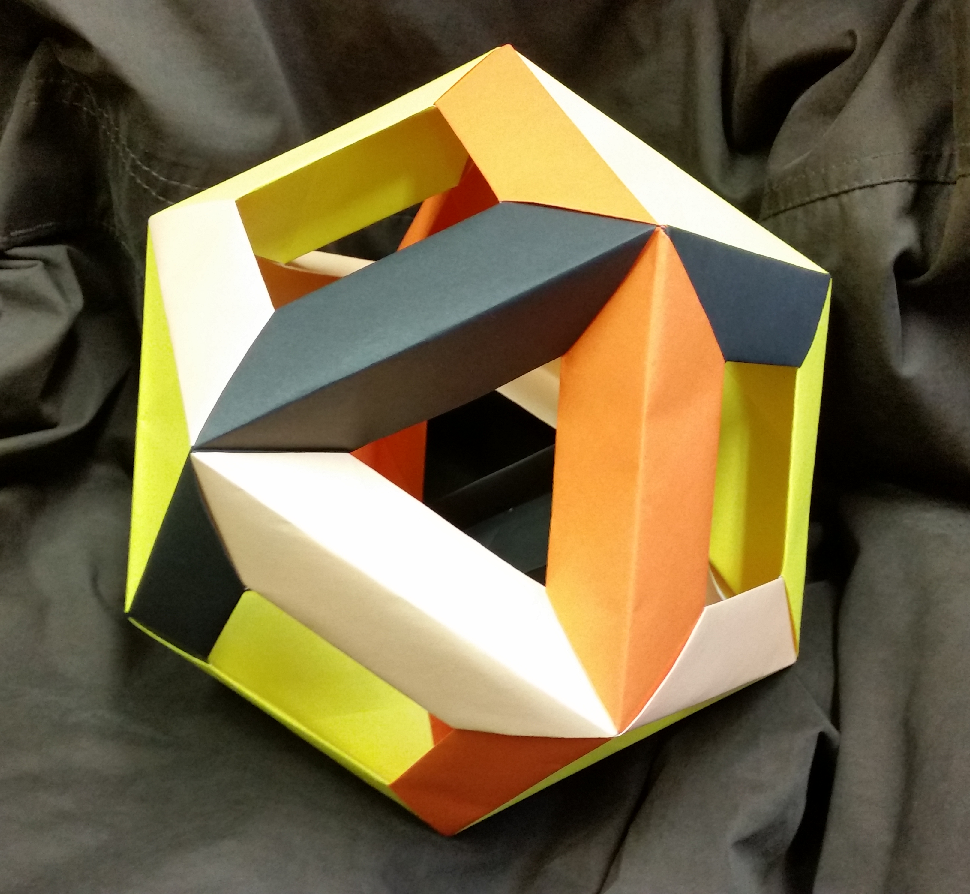
Snub Dodecahedron
Constructed at University of Haifa, 2019.
Made of 150 identical pieces in 6 colors.
The symmetry group is A5 and the coloring consists of orbits of a subgroup isomorphic to D10.
Cuboctahedron
Constructed at University of Haifa, 2017.
Made of 24 identical pieces in 4 colors.
The symmetry group is S4 and the coloring proves it: any rotation preserving the solid induces a permutation of the colors.
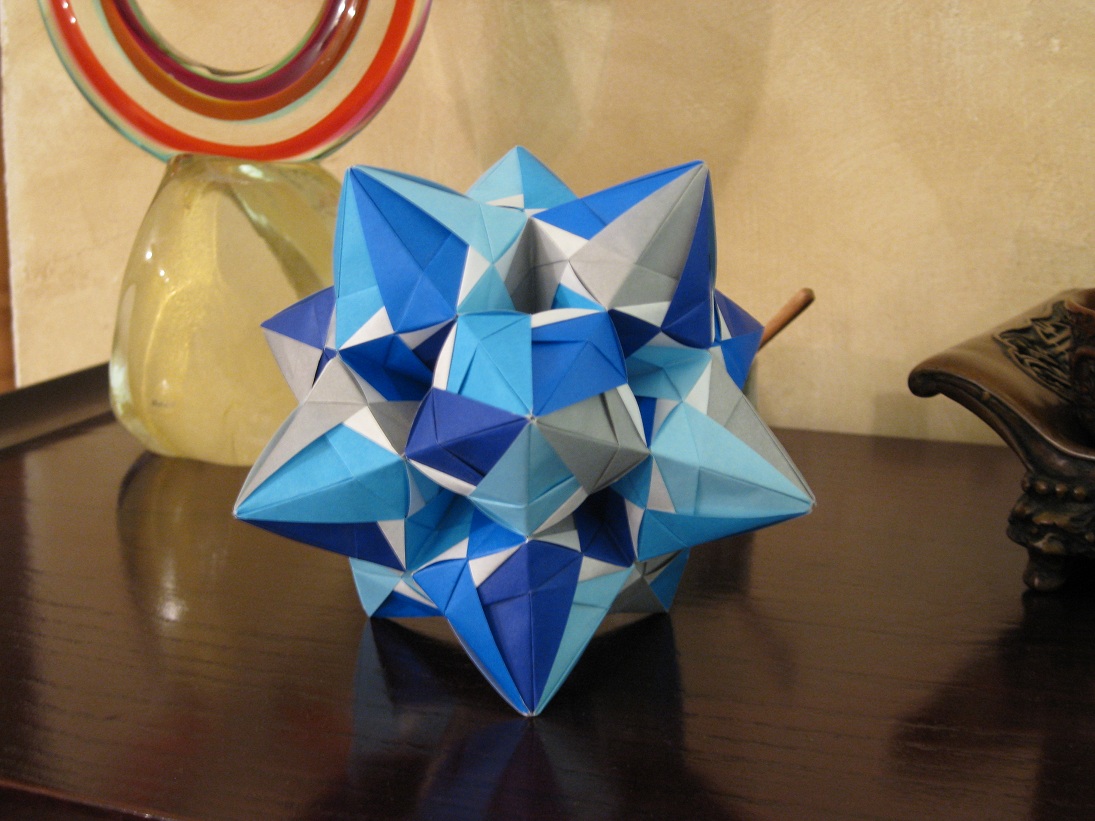
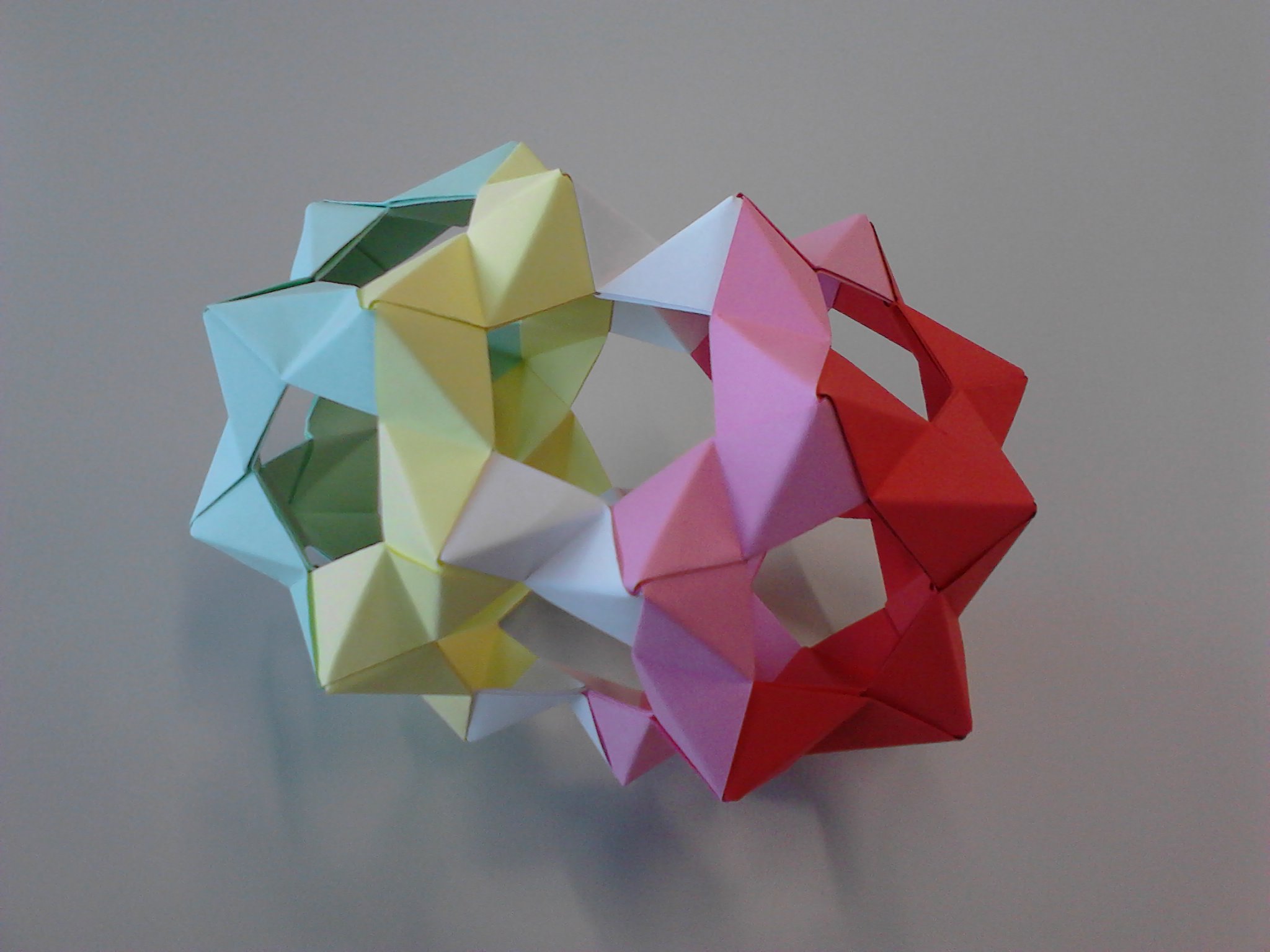
Icosidodecahedron (with Pyramids on the Faces)
Made of 60 identical pieces in 5 colors.
The symmetry group is A5 and the coloring proves it: any rotation preserving the solid induces a permutation of the colors.
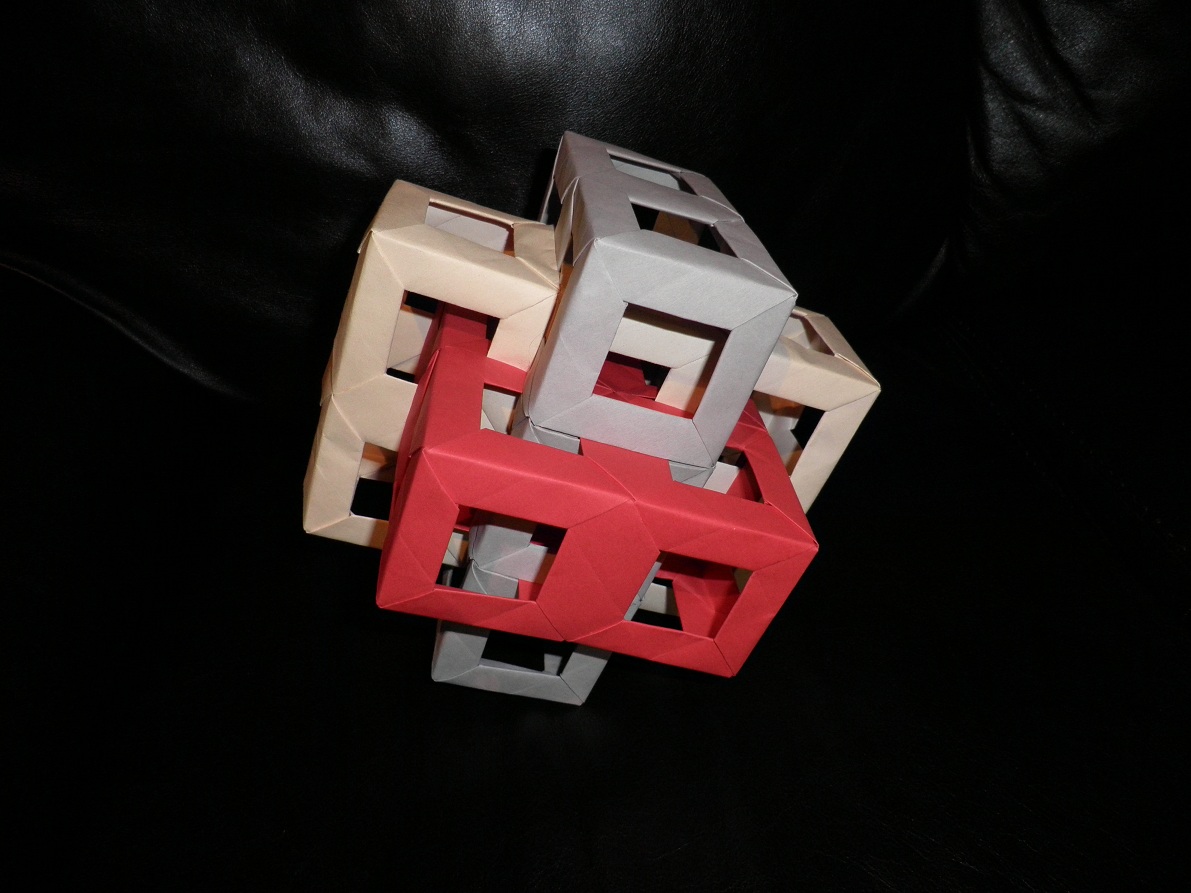
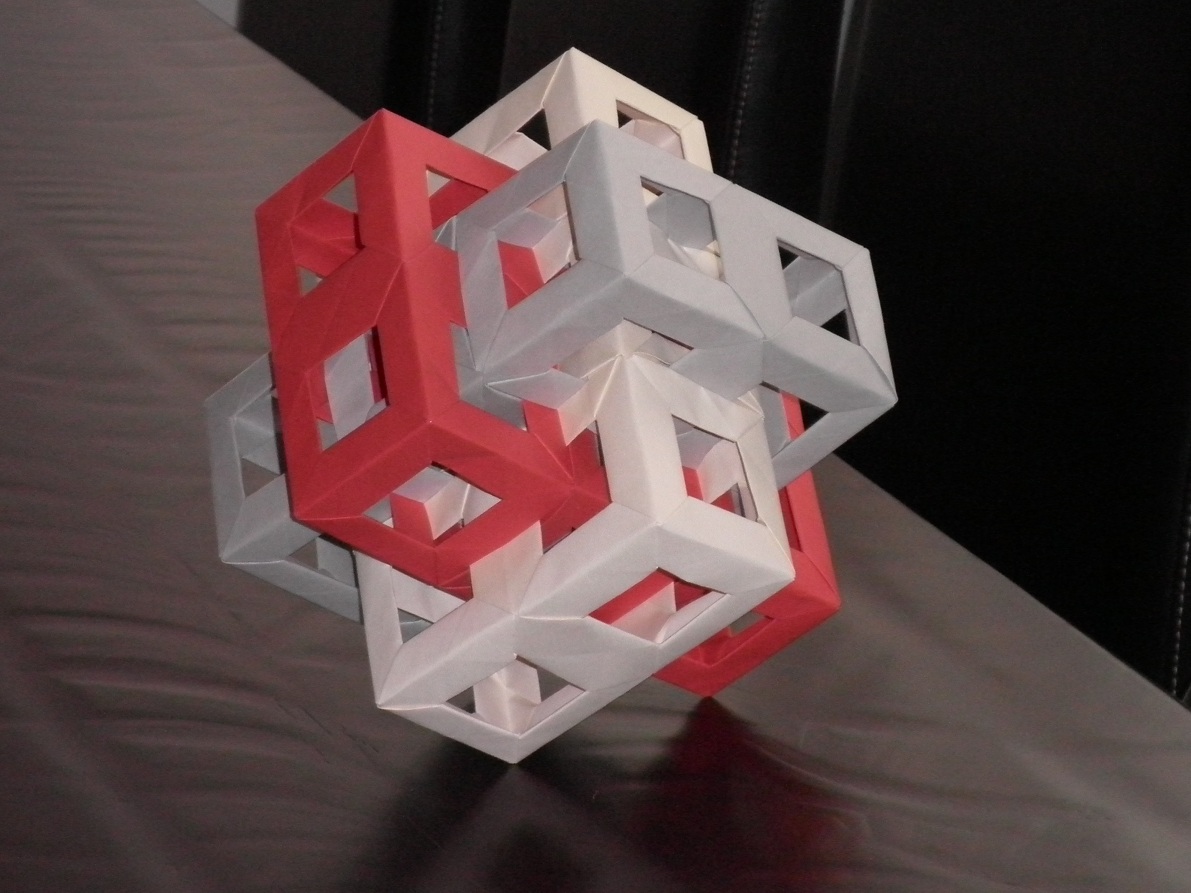
Three Intersecting Boxes
Each of the boxes is made of 56 pieces (a total of 168 pieces).
The pieces are not identical and divide into two kinds. One of the kinds requires scissors to make (sorry).
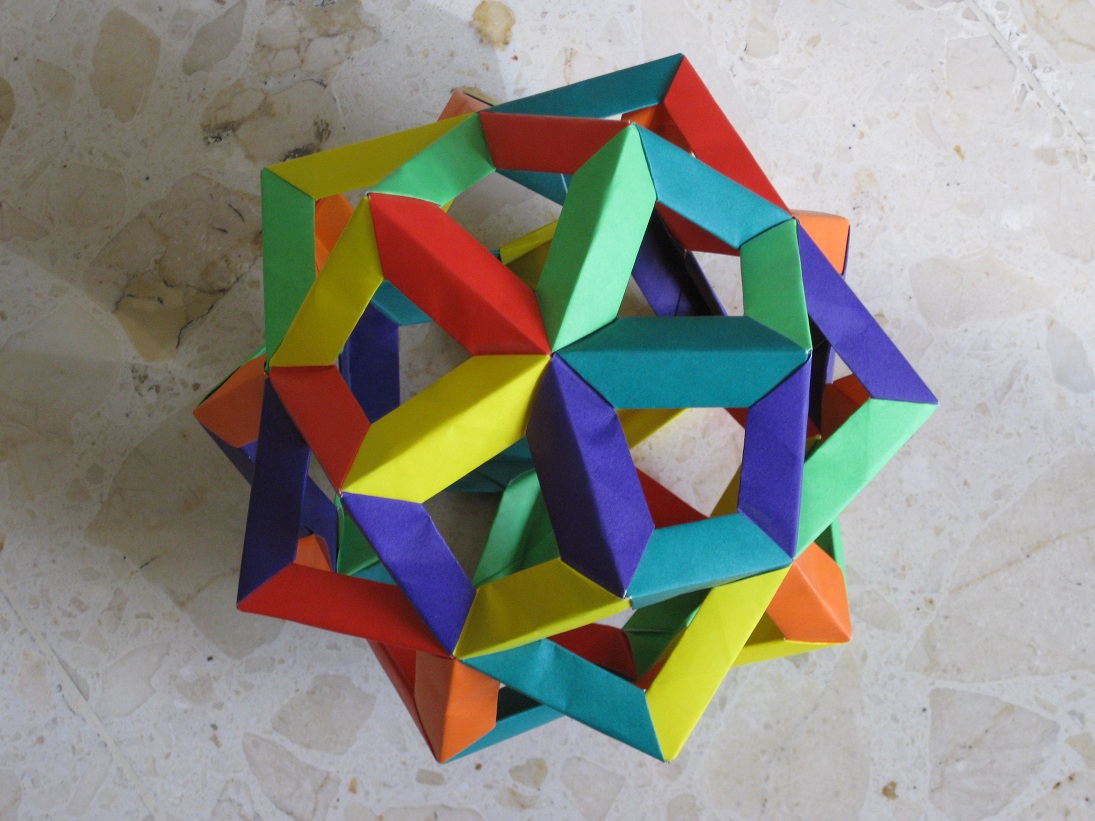
Icosahedron (with Pyramids on the Faces)
Made of 60 identical pieces in 6 colors.
The symmetry group is A5. The coloring is just the orbits of one of the copies of D5 in A4 (6 colors for 6 orbits).
Omega Stars
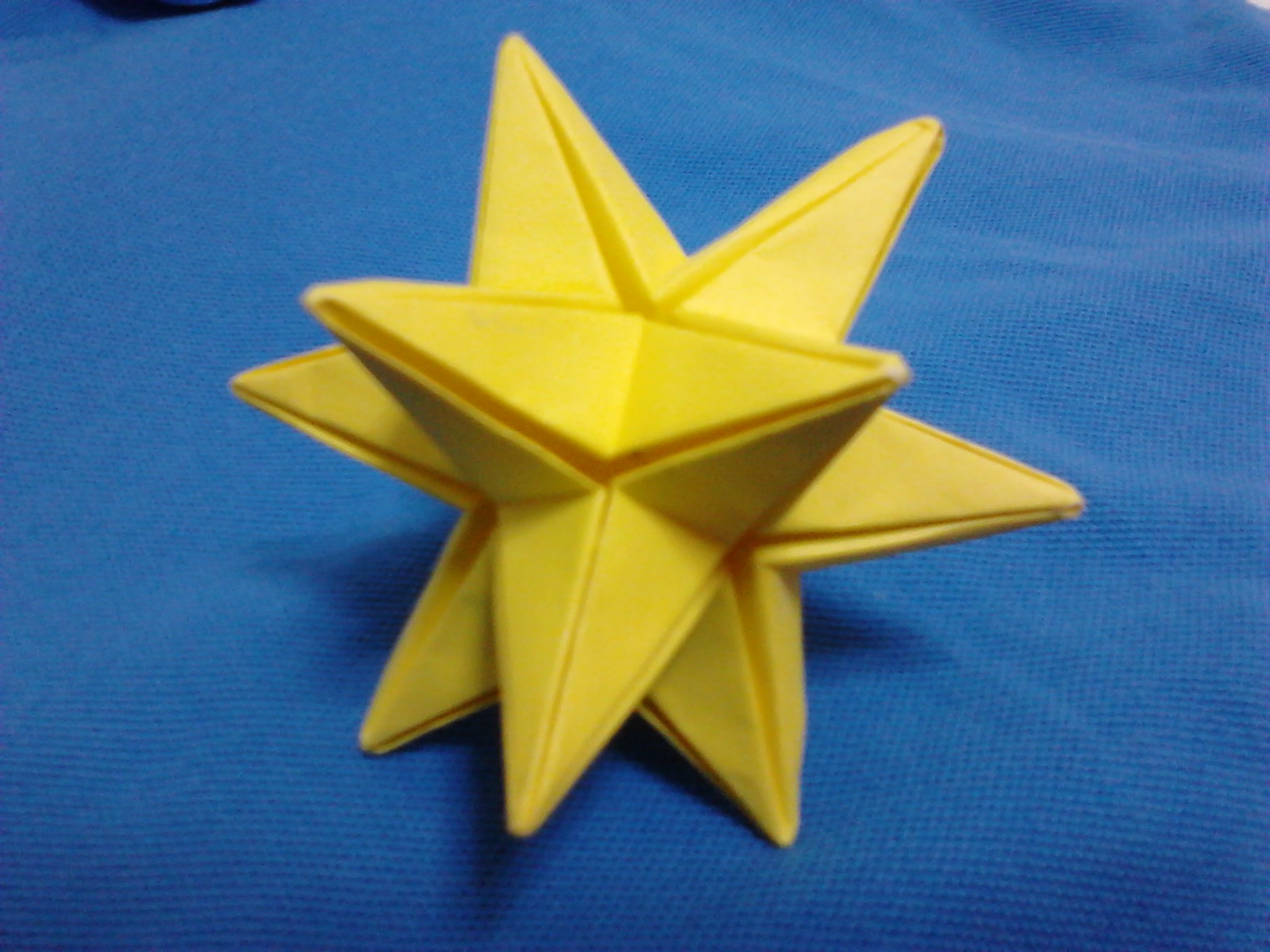
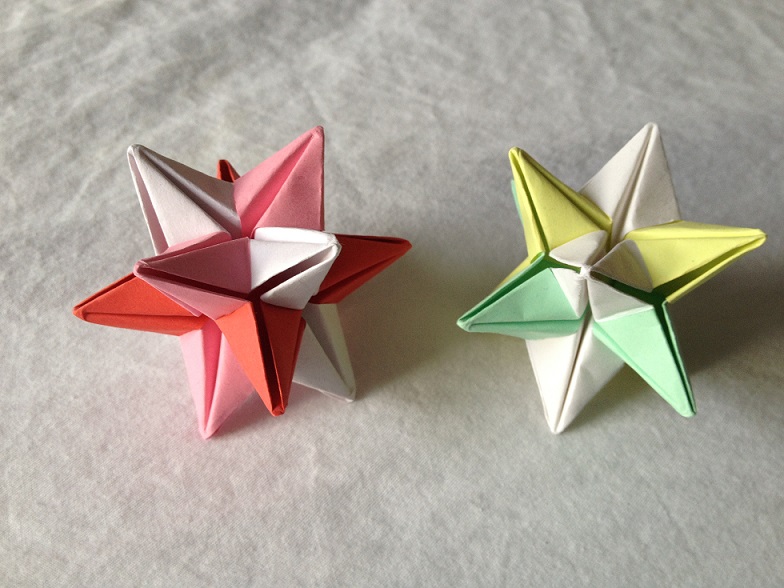
Made of 6 identical pieces. The points of the star form a root system of type A3, or alternatively, a cuboctahedron.
Buckyball (or Truncated Icosahedron)
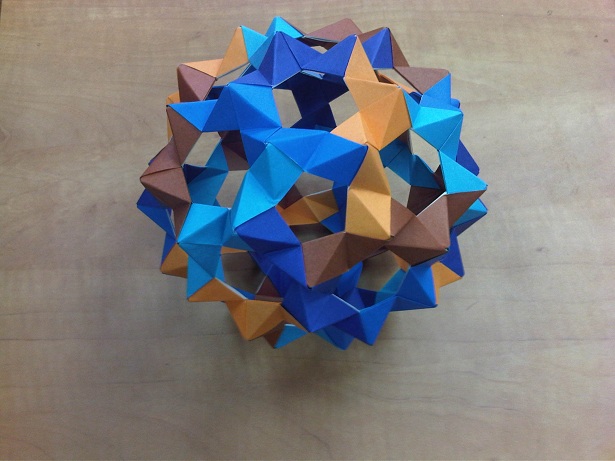
Made of 90 identical pieces (the so called "PHiZZ units") in 5 colors.
The symmetry group is A5 and the coloring "proves" it. This map induces an isomorphism of the symmetry group into the group of even permutations on 5 colors.
Another Buckyball
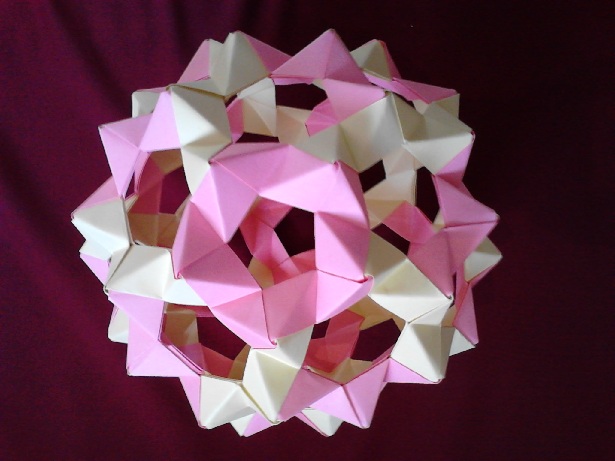
Made of 90 identical pieces (the so called "PHiZZ units") in 2 colors.
The symmetry group of the coloring is dihedral.
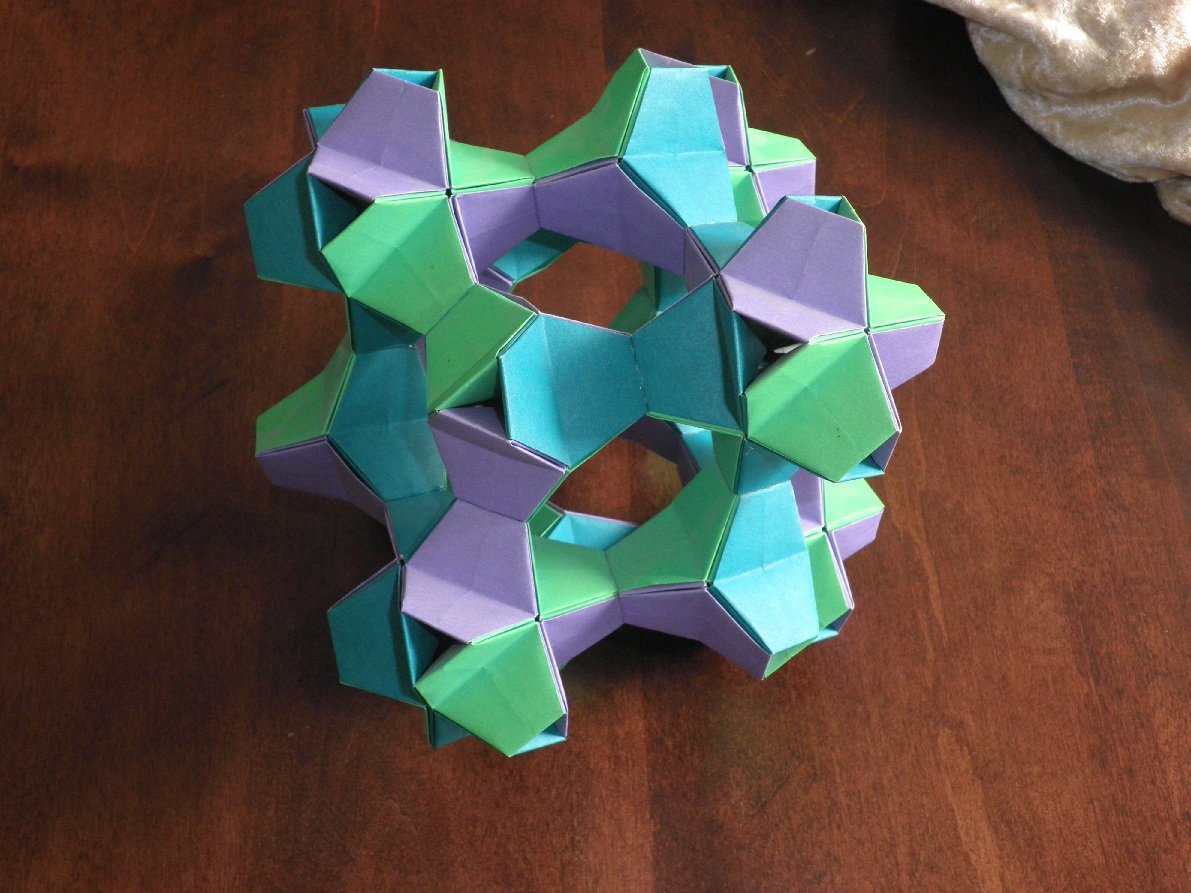
Tetrahedral-Octahedral Honeycomb
This construction is made of 6 octahedra and 8 tetrahedra (literally) glued together to form a tetrahedral-octahedral honeycomb. The construction can also be understood as a rhombic dodecahedron.
Made of 120 "turtle units" in three colors.

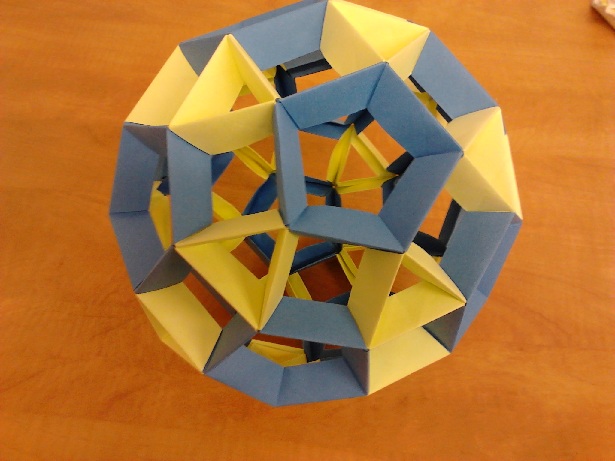
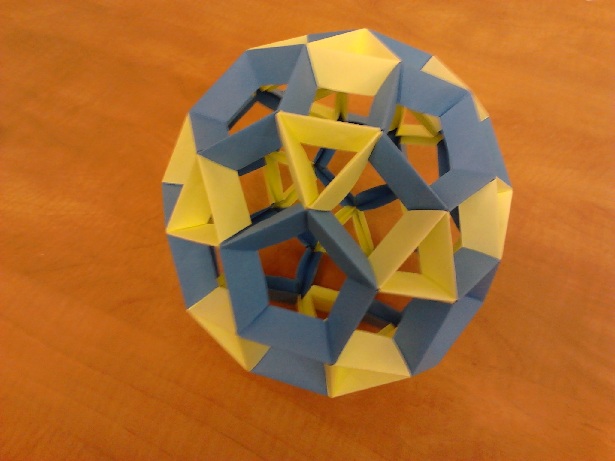
Dodecahedron
Made of 30 identical pieces in 6 colors.
The symmetry group is A5. The coloring is just the orbits of one of the copies of D5 in A4 (6 colors for 6 orbits).
Rhombicosidodecahedron
Made of 120 identical pieces (standard 135 degrees units) in two colors.
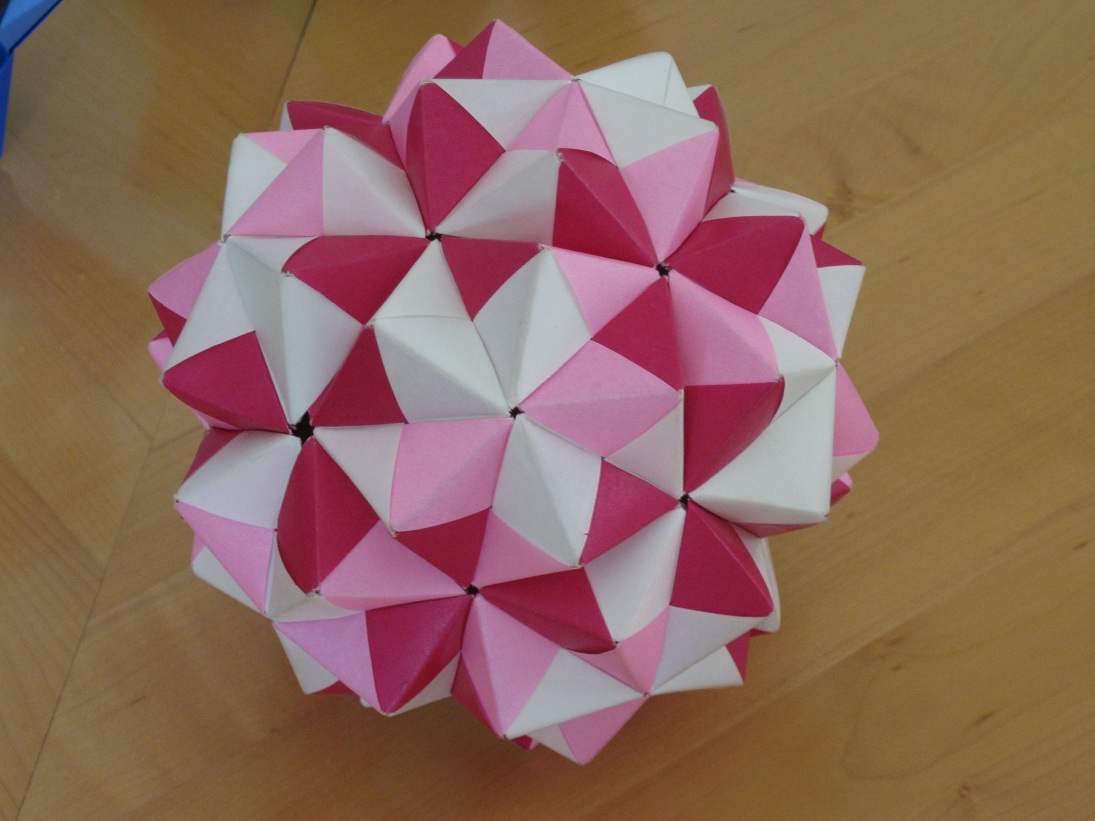
Flowery Thing
Made of 90 identical pieces in 3 colors.
It is not easy to explain what is this solid. Its symmetry group is A5, so it is of the same family as the dodecahedron and icosahedron.
The coloring is unbalanced in the sense that the amount of units of each color is different. It is designed to resemble cherry flowers.
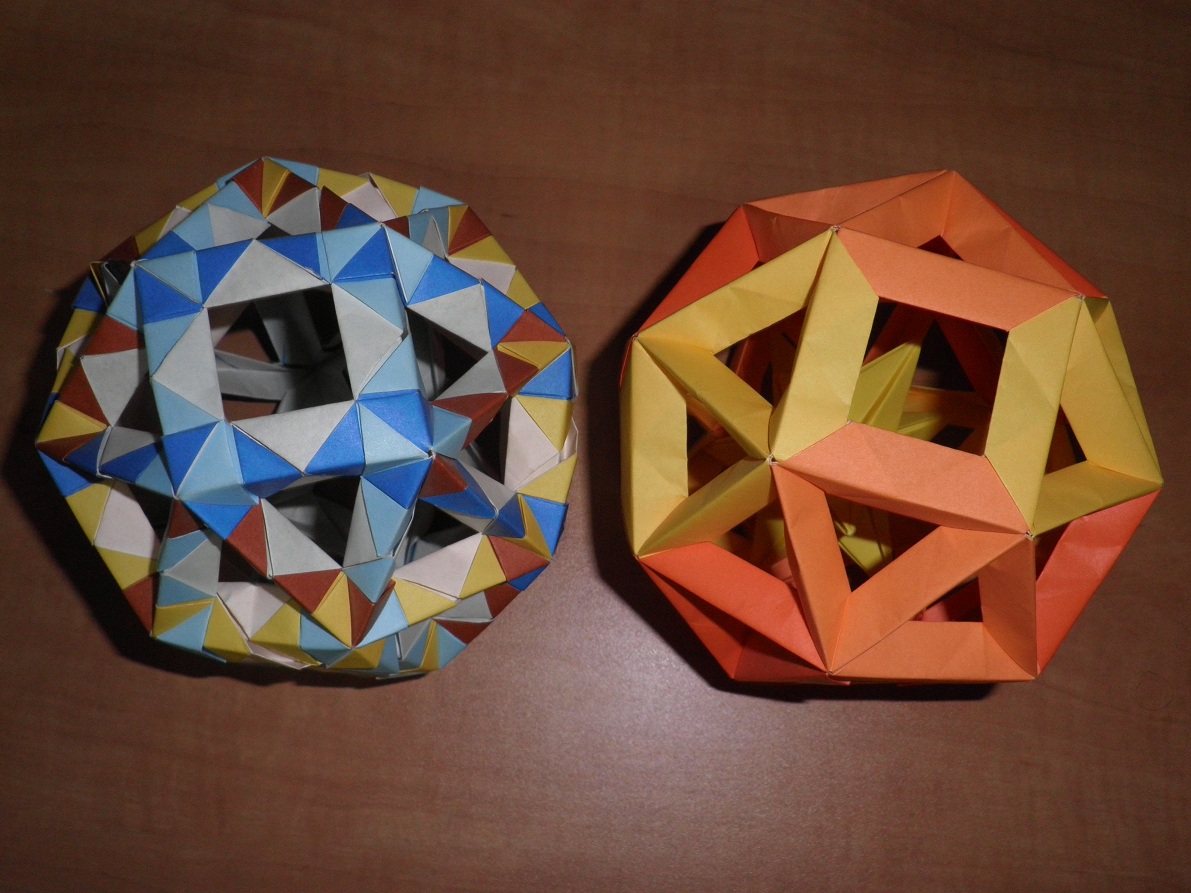
Snub Cubes
Each of the snub-cubes is made of 60 identical pieces. The right snub-cube contains an "omega star" made of additional 6 pieces.
The symmetry group is S4.
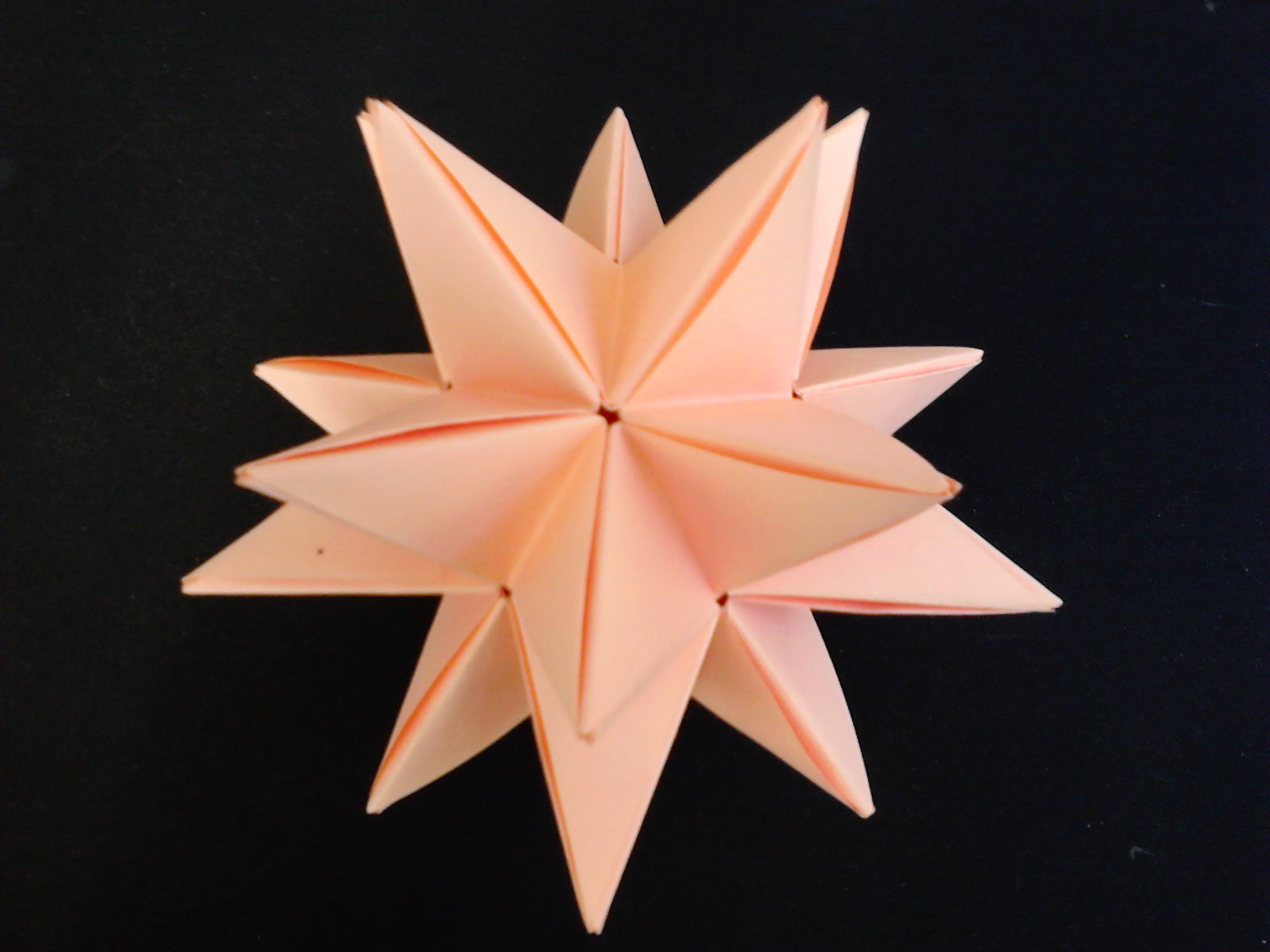
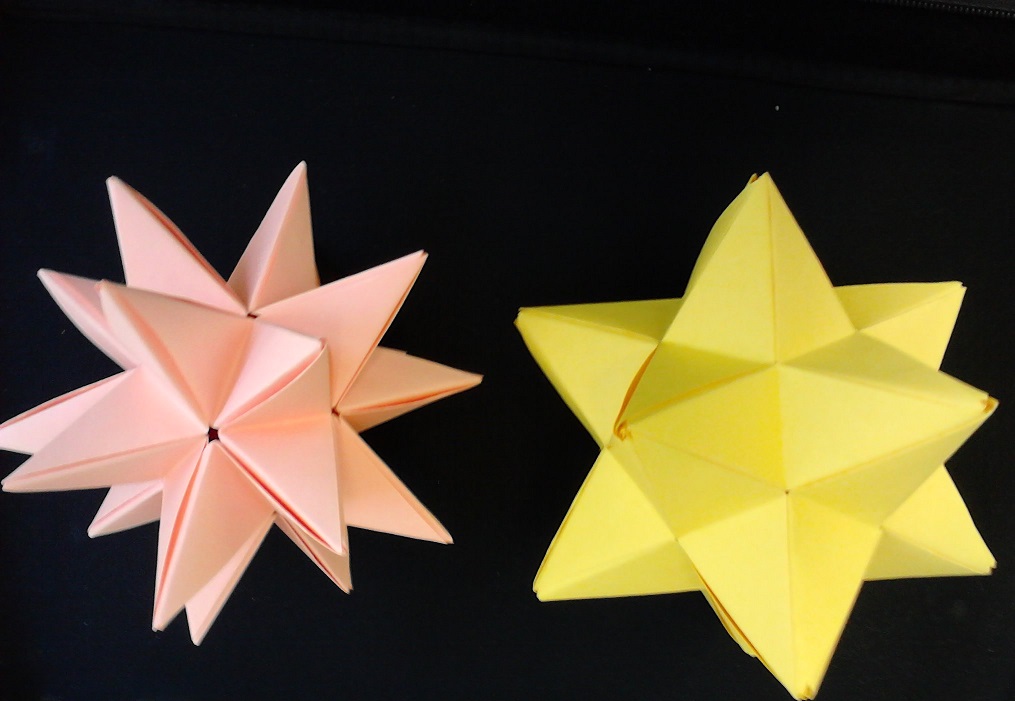
Small and Great Stellated Dodecahedra
Each polyhedra is made of 30 identical pieces. These polyhedra are two out of the four regular star polyhedra (Kepler–Poinsot polyhedra). Constructed on 2014 at HUJI, Jerusalem.
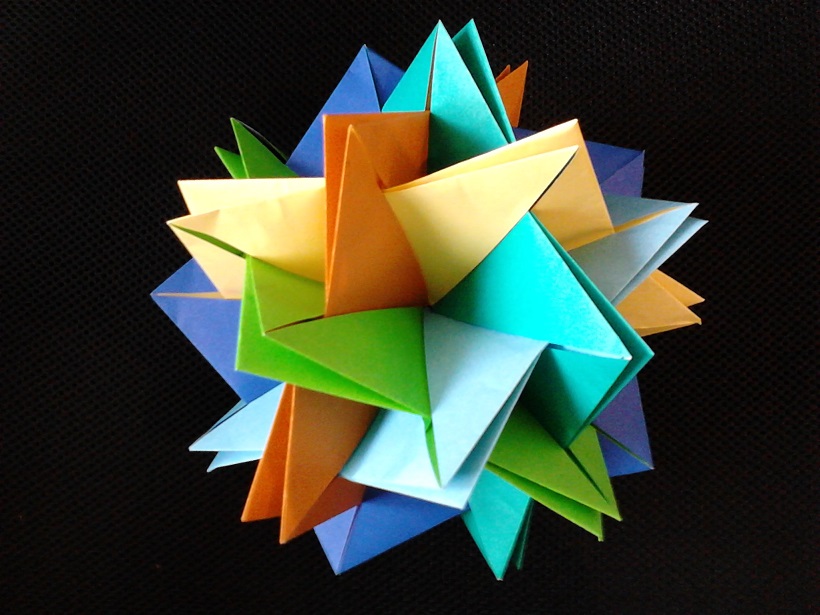
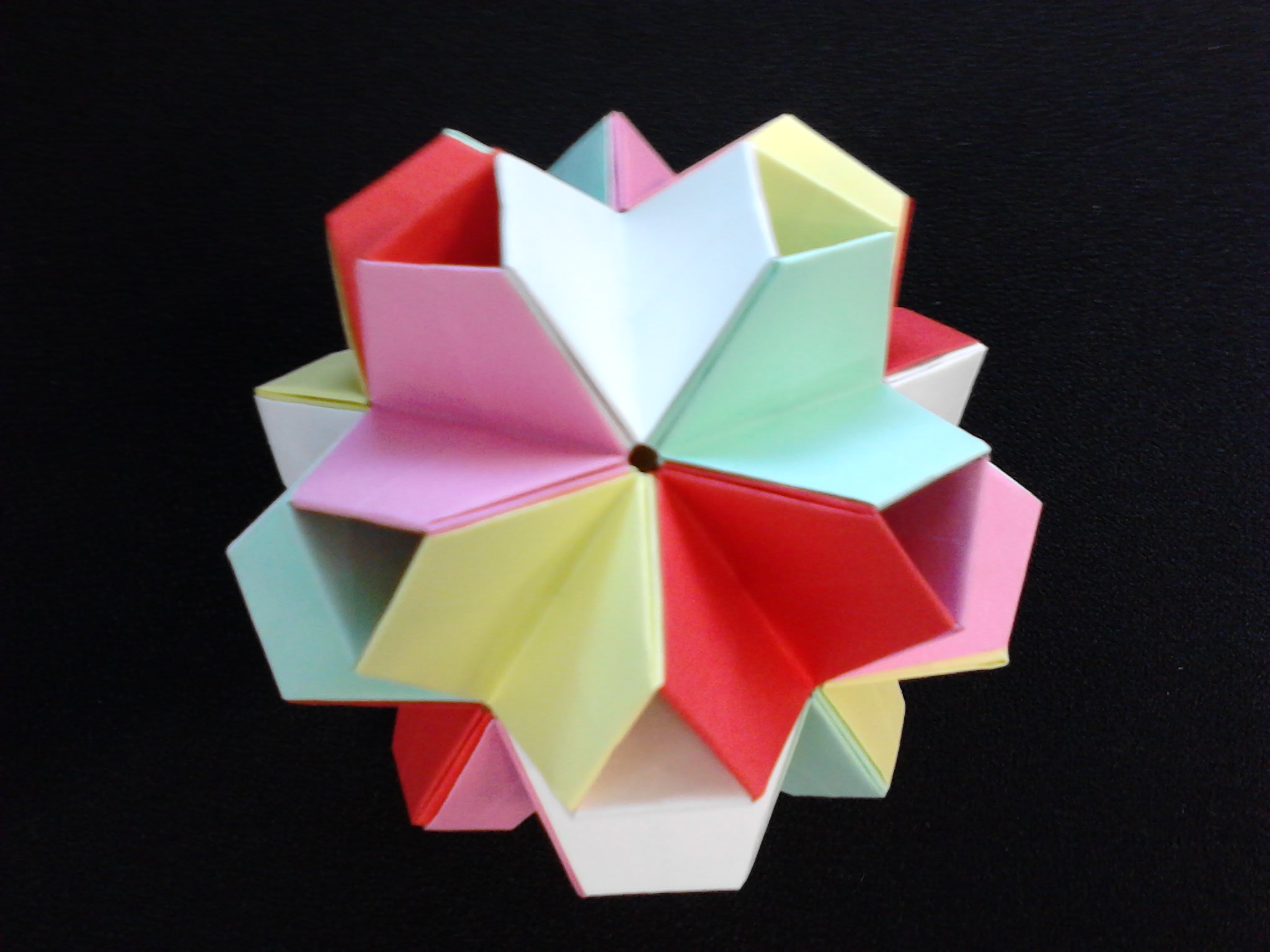
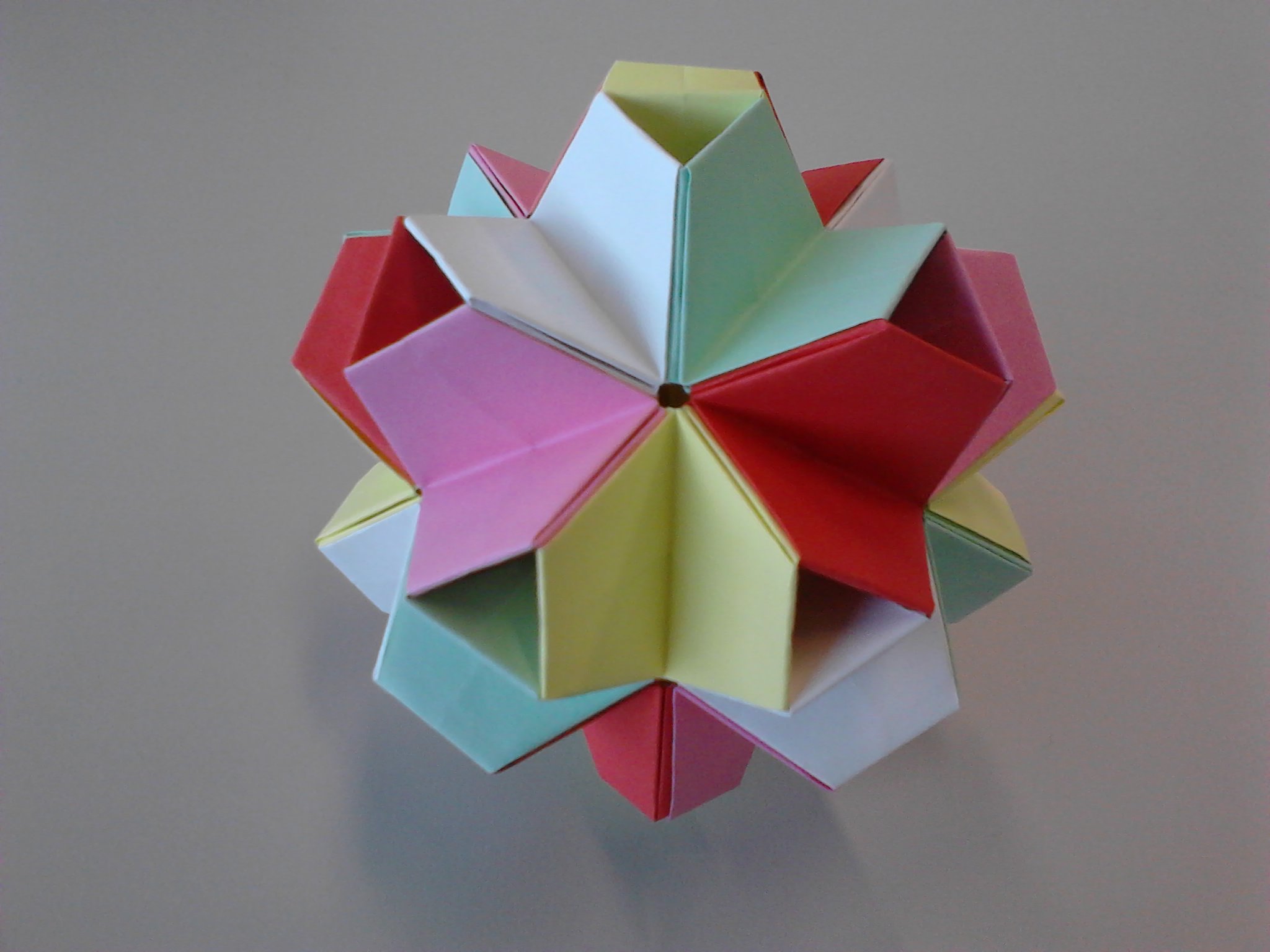
Blintz Icosahedron
The model is called "Blintz Icosahedron". It is not an "honest" icosahedron, but rather a tesselation of six planes with the same symmetry group. Made of 30 identical pieces in 6 colors. Constructed on 2013 in Katamon, Jerusalem.
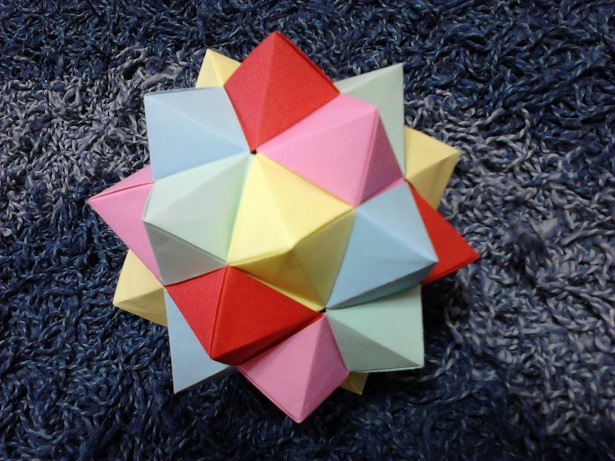
Icosahedron (with Truncated Pyramids on the Faces)
Made of 30 identical pieces ("turtle unit") in 5 colors. Constructed on 2014 in EPFL, Lausanne, Switzerland.
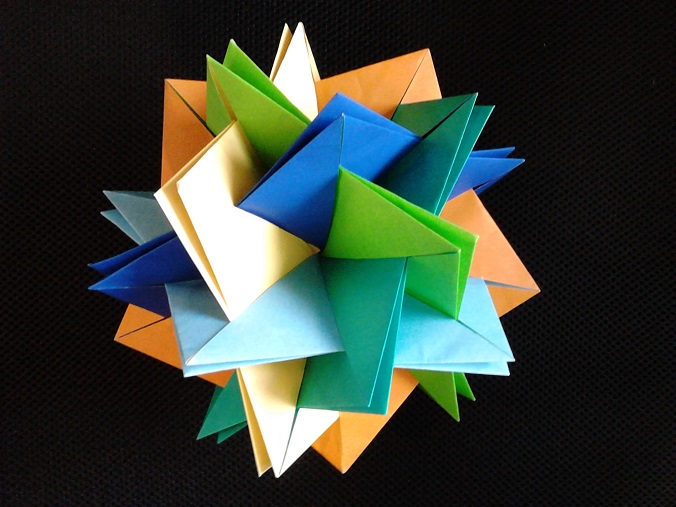
A Compound of Five Octahedra
Made of 30 identical pieces in 5 colors. Constructed on 2015 in Netanya, Israel.
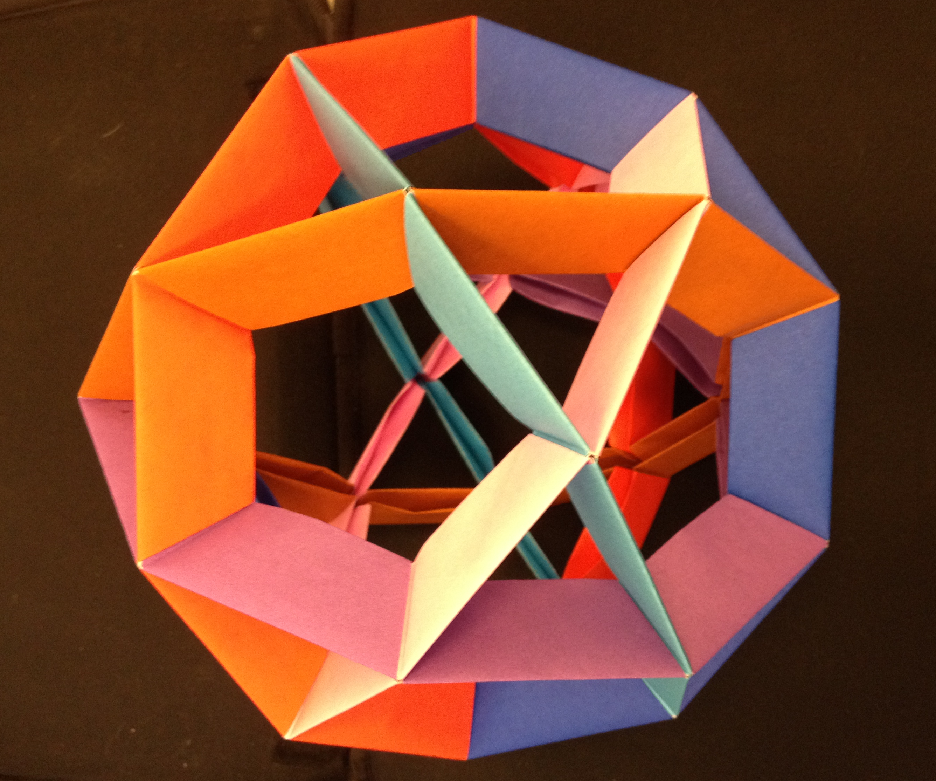
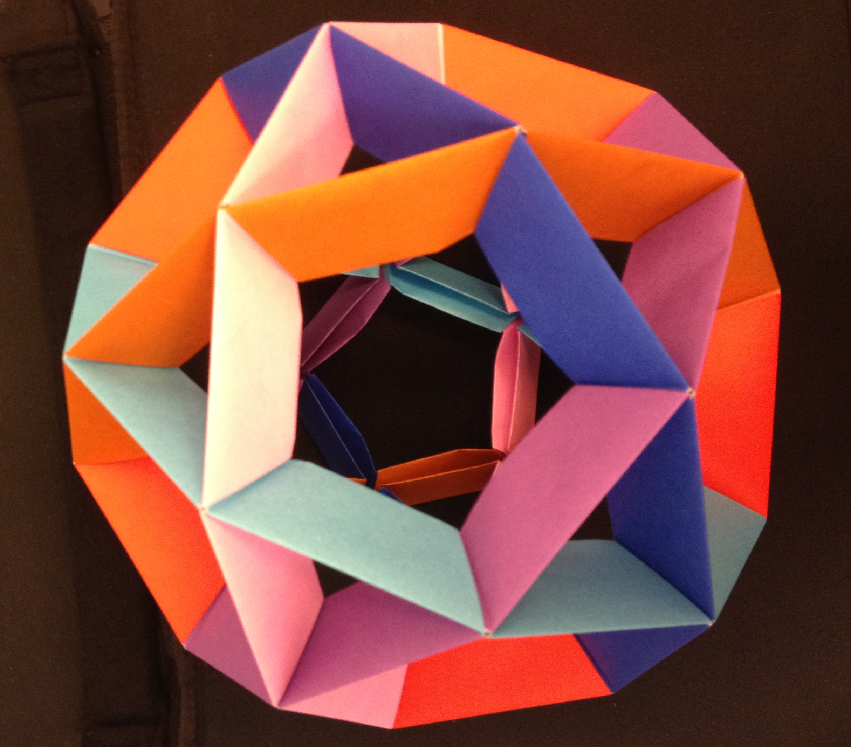
Icosidodecahedron
Made of 60 identical pieces in 6 colors.
Constructed in Vancouver, 2016.
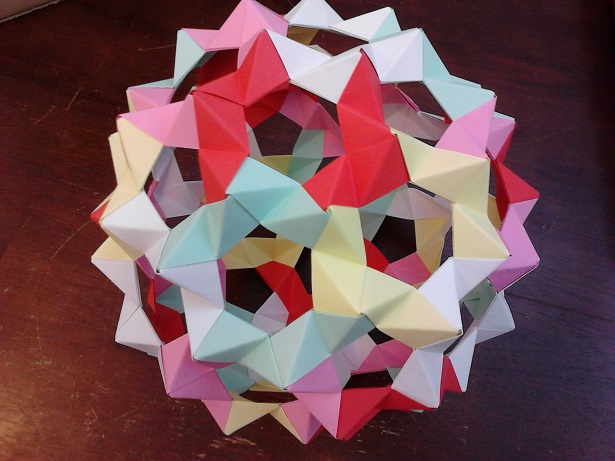
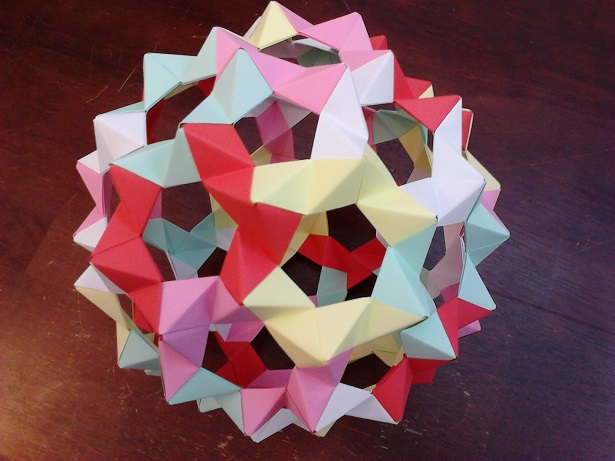
Fullerene with 30 Hexagons and 80 Vertices ("C80")
A fullerene is a polytop made of hexagons and pentagons such that three faces meet at every vertex. This forces the number of pentagons to be 12.
This fullerene has 30 hexagons and 12 pentagons. It is made of 120 identical pieces in 5 colors. Constructed on 2015 in Vancouver, Canada.
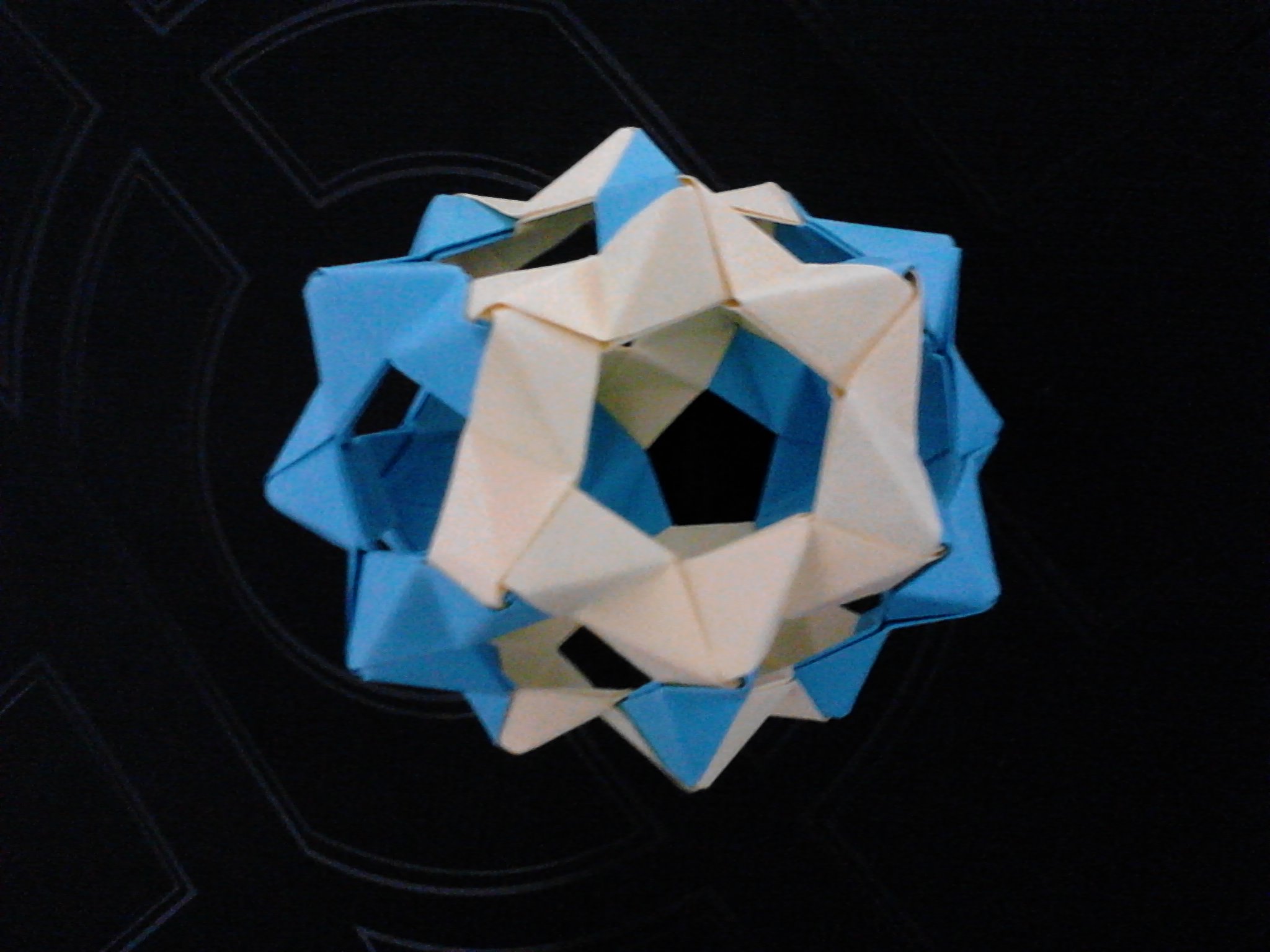
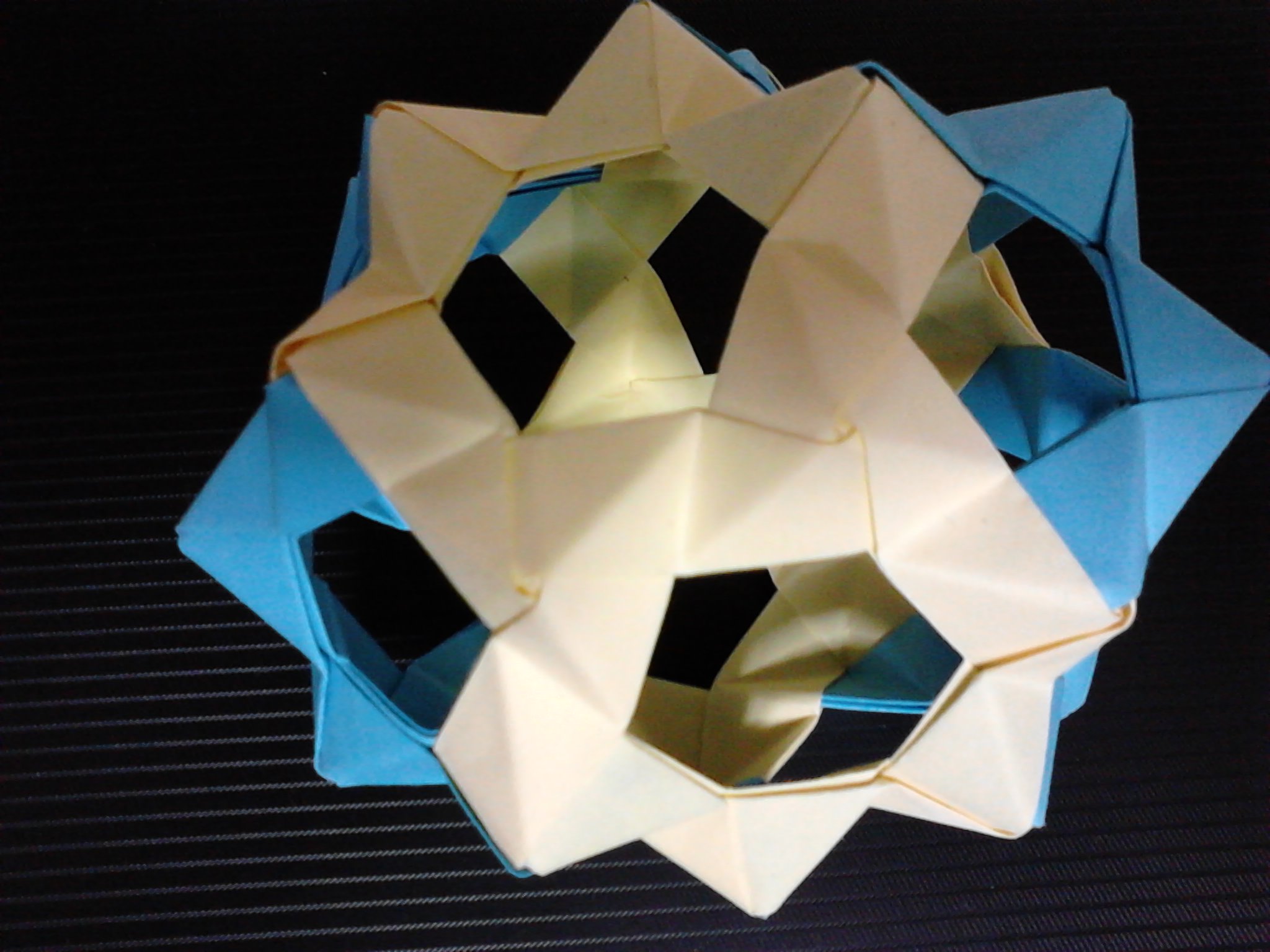
Fullerenes with 3 and 4 Hexagons
All fullerenes with 3 and 4 hexagonal faces.
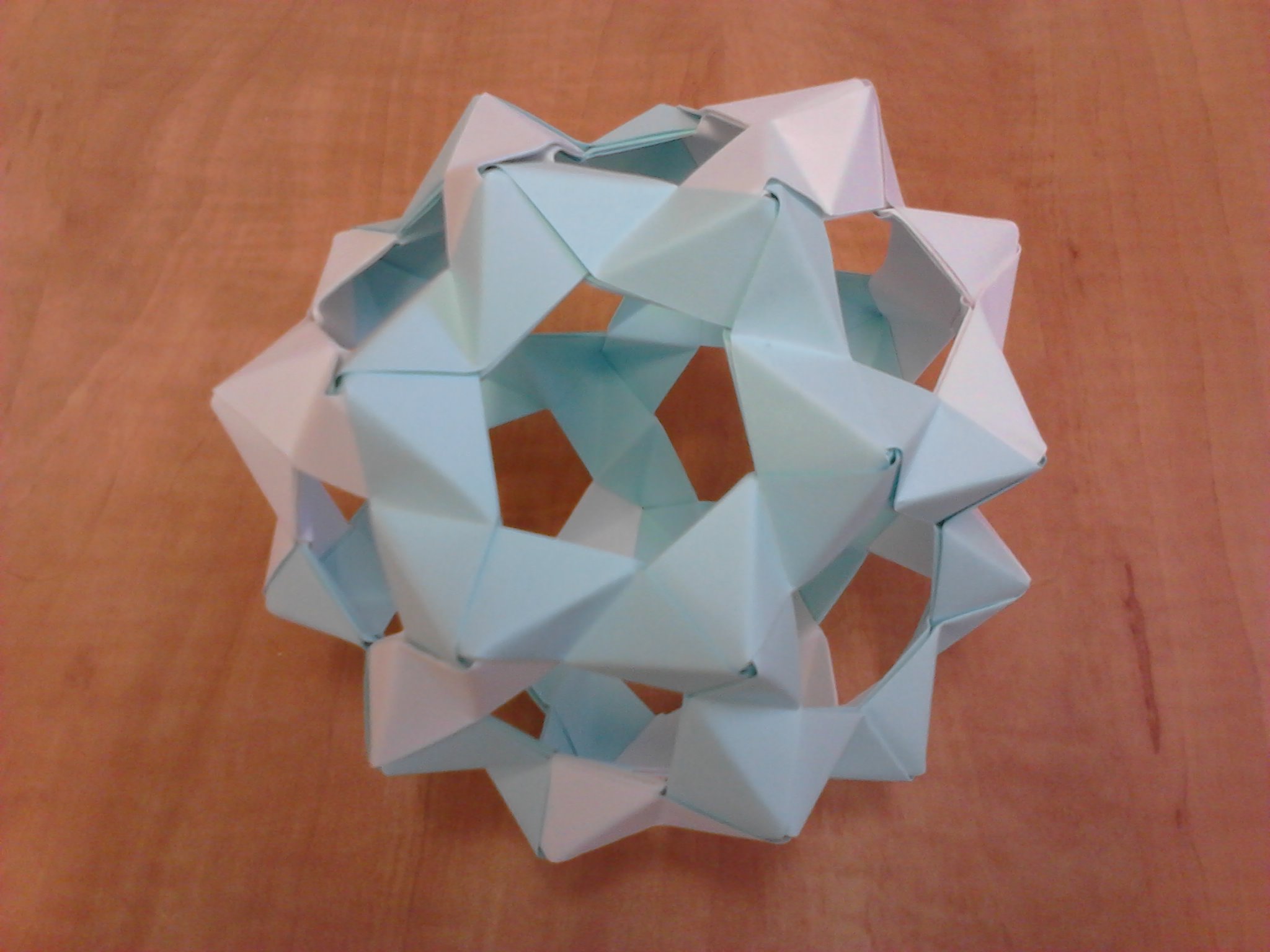
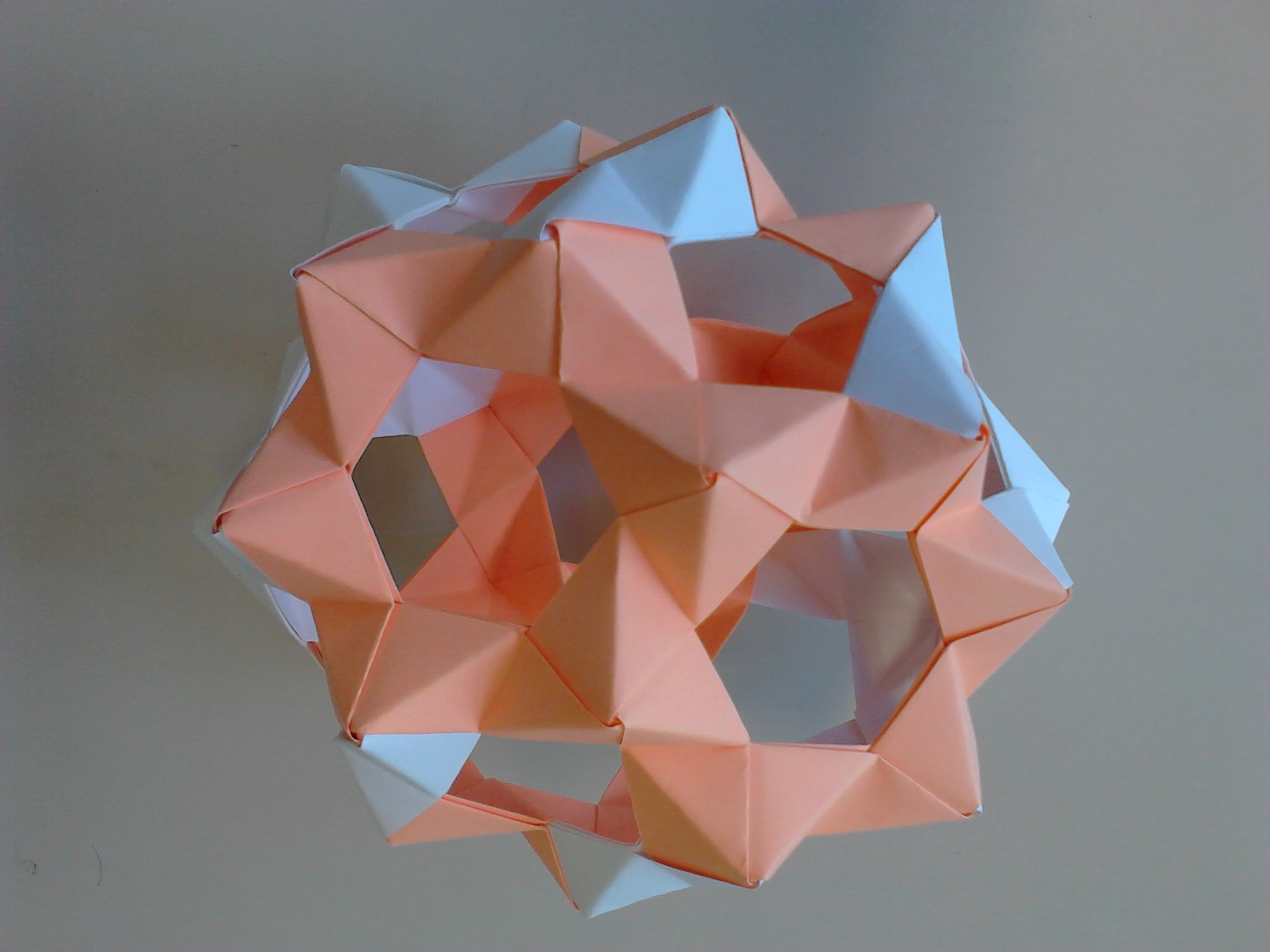
Fullerenes with 5 Hexagons
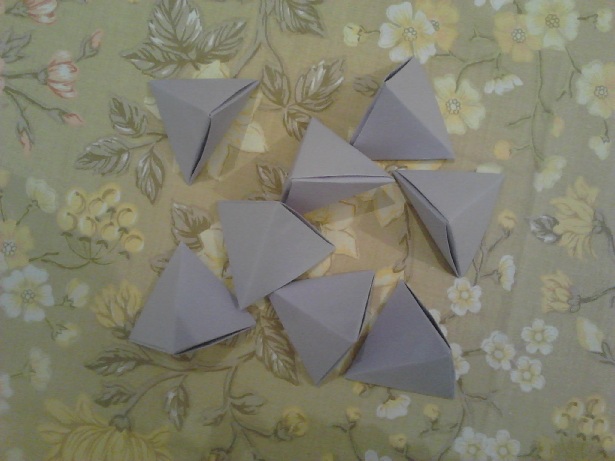
All fullerenes with 5 hexagonal faces.
A3-tilde Coxeter Cells
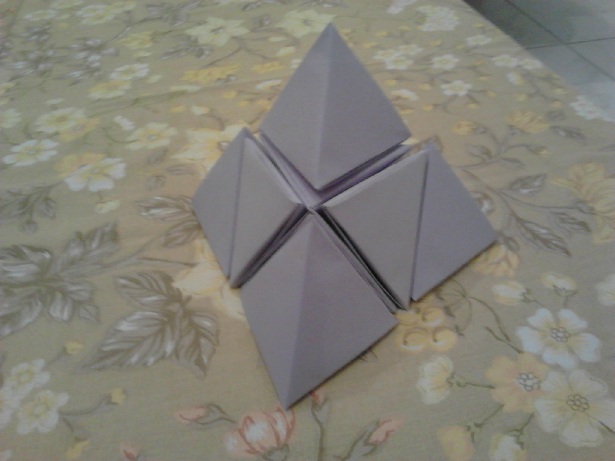
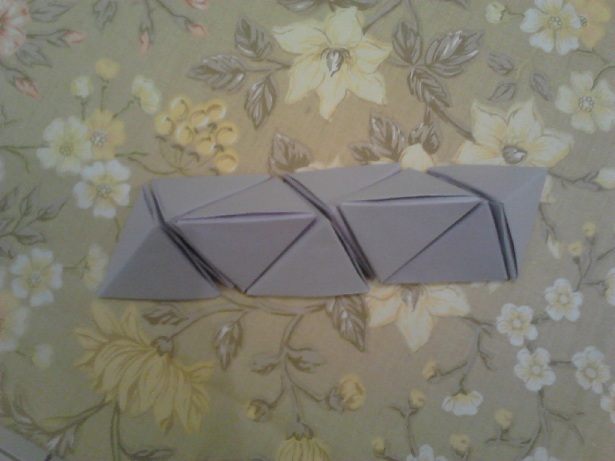
Each of these pyramids is made of 2 rhombic units (by Nick Robinson) of different orientation.
The tetrahedron obtained in this manner is a basic cell of the euclidean coxeter complex of type A3-tilde. As a result, one can tessellate a 3-dimensional euclidean space with it. Eight A3-tilde cells can tessellate an A3-tilde cell twice their size.
C3-tilde Coxeter Cells
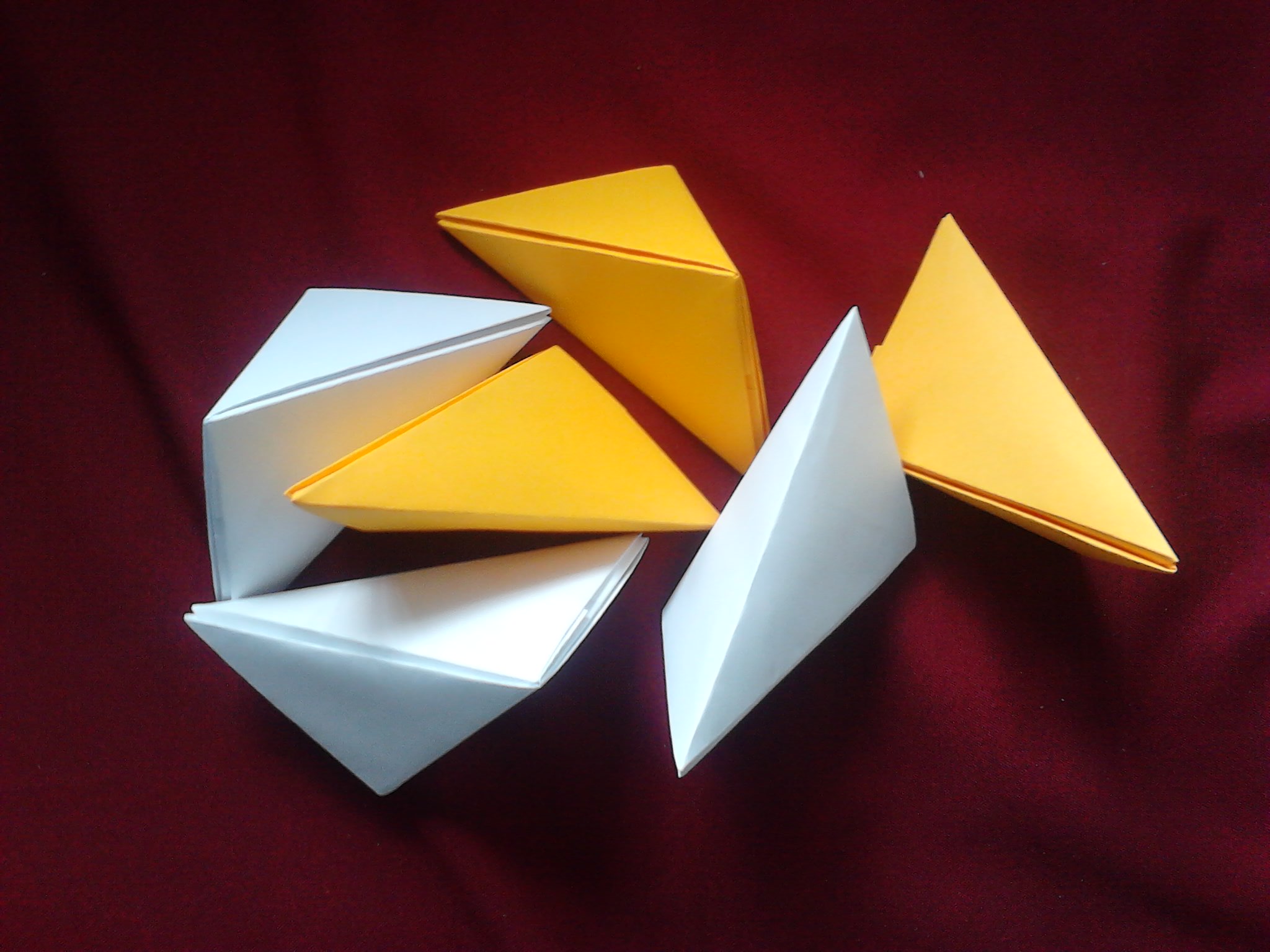
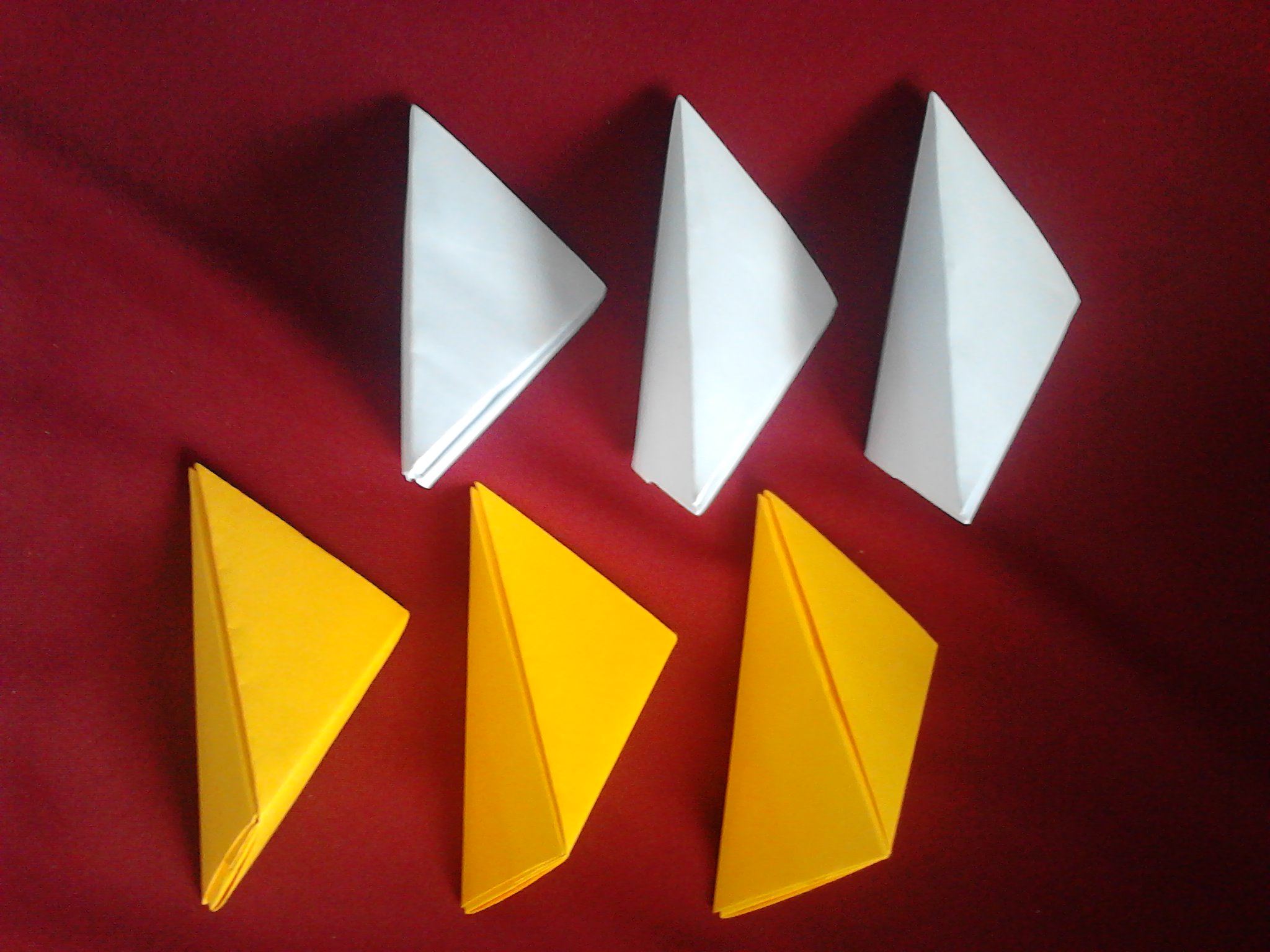
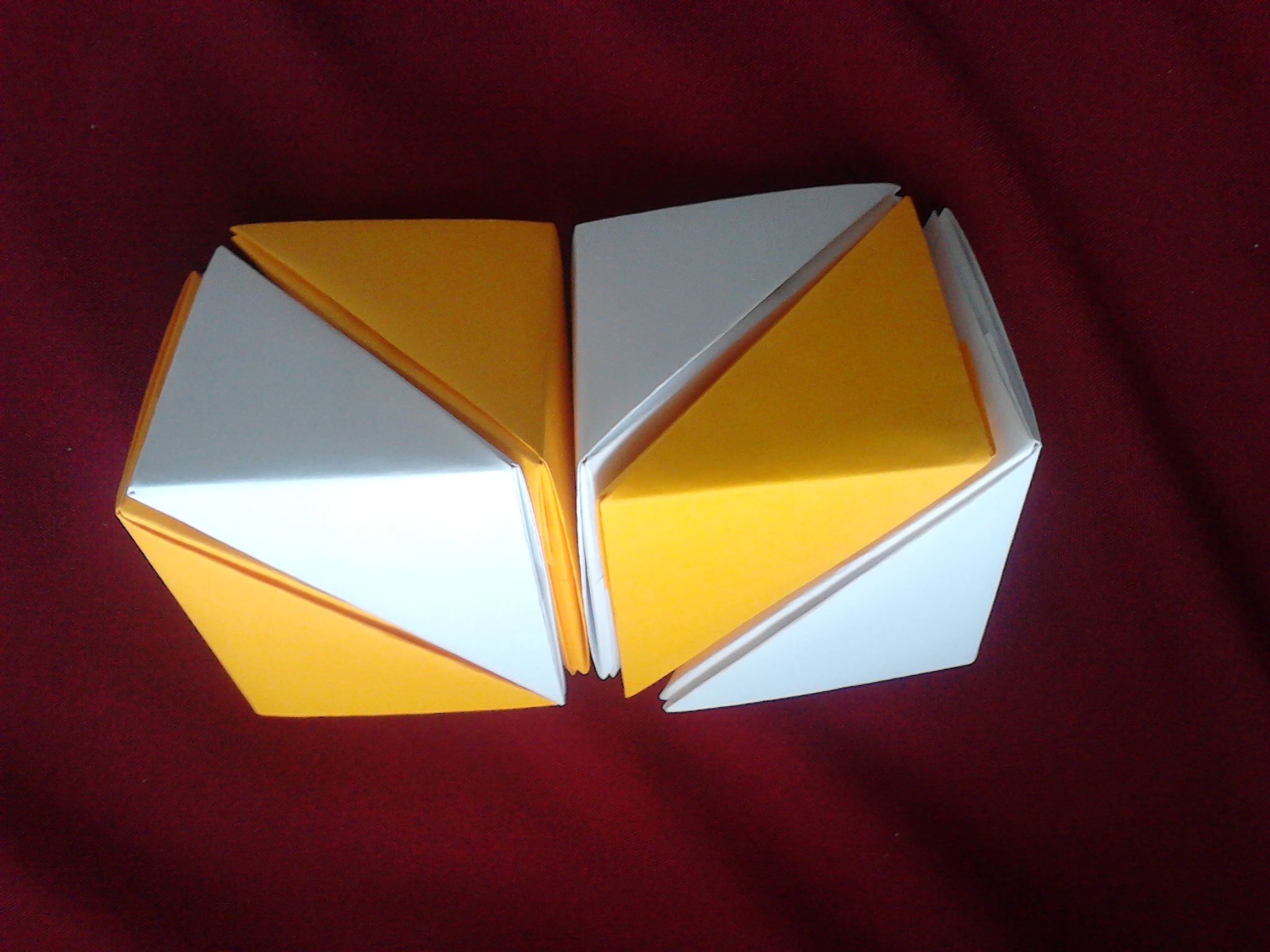
Each tetrahedron is made of 2 non-identical units of self-design. The orange and white constructs have reversed orientations.
The tetrahedron forms a basic cell of the euclidean coxeter complex of type C3-tilde. Eight C3-tilde cells can tessellate a twice bigger C3-tilde cell.
Miscellaneous
Useful Links
- Department of Mathematics at University of Haifa.
Puzzle Games
I enjoy puzzle games (when I have the time, at least). Here are some of my favorites:
Music
I play the clarinet as a hobby, usually classical chamber music.
- A video of me playing with friends the first two movements of Mozart's clarinet quintet.
- An arrangement of C. Franck's violin sonanta, mvt. I, for B clarinet.
- A very long list of musical jokes.